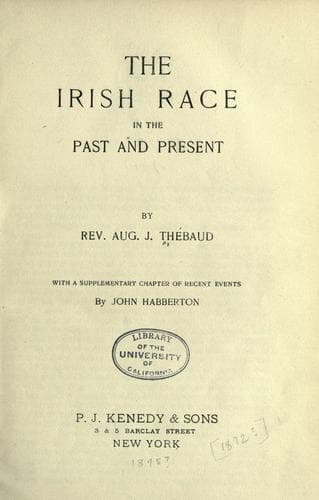
The Irish Race in the Past and the PresentThébaud, Augustus J.
History
The Irish Race in the Past and the Present
Thébaud, Augustus J.
Ireland -- History
Nor was it only in the erection of those edifices that a cheerful
impulse, which overlooked or overcame all difficulties, was
displayed. The monastic life was not all the time a life of
penance and gloomy austerity, but of active work also and
overflowing feeling, of true poetry and enthusiastic exultation.
We read in the fragments we still possess how, on the arid rock
of Iona, Columba remembered his former residence at Derry, with
its woods of oaks and the pure waters of its loughs. In all the
lives of Irish saints we read of the deep attachment they always
preserved for their country, relatives, and friends; what they
did and were ready to do for them. And though all this was at
bottom but a natural feeling, the extent to which it was carried
will make us better acquainted with the Irish character, and
explain more clearly that extraordinary expansion of soul which,
in the domains of the supernatural, surpassed every thing
witnessed elsewhere.
"In a monastery two brothers had lived from childhood. The elder
died, and while he was dying the other was laboring in the
forest. When he came back, he saw the brethren opening a grave
in the cemetery, and thus he learned that his brother was dead.
He hastened to the spot where the Abbot Fintan, with some of his
monks, were chanting psalms around the corpse, and asked him the
favor of dying with his brother, and entering with him into the
heavenly kingdom. 'Thy brother is already in heaven,' replied
Fintan, 'and you cannot enter together unless he rise again.'
Then he knelt in prayer, the angels who had received the holy
soul restored it, and the dead man, rising in his bier, called
his brother: 'Come,' said he, 'but come quickly; the angels
await us.' At the same time he made room beside him, and both,
lying down, slept together in death, and ascended together to
the kingdom of God."
This anecdote may tend better than any thing else to show us how
Nature and grace were united in the Irish soul, to warm it,
purify it, exalt it above ordinary feelings and earthly passions,
and keep it constantly in a state of energy and vitality
unknown to other peoples. For, in what page of the
ecclesiastical history of other nations do we read of things
such as these?
Public-domain text, read in full here on John Shaqi.
Reviews
Reviews
No reviews yet
Be the first to share your thoughts on this work.
Elsewhere in the archive
Join the Discussion
Join the discussion
Sign in to leave a comment or review.
Sign InorCreate an account