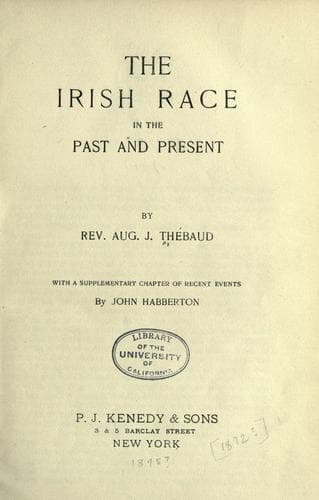
The Irish Race in the Past and the PresentThébaud, Augustus J.
History
The Irish Race in the Past and the Present
Thébaud, Augustus J.
Ireland -- History
For several centuries the Irish continued in the happy state
described in the last chapter. While the whole European
Continent was convulsed by the irruptions of the Germanic tribes,
and of the Huns, more savage still, the island was at peace,
opened her schools to the youth of all countries--to Anglo-
Saxons chiefly--and spread her name abroad as the happy and holy
isle, the dwelling of the saints, the land of prodigies, the
most blessed spot on the earth. No invading host troubled her;
the various Teutonic nations knew less of the sea than the Celts
themselves, and no vessel neared the Irish coast save the
peaceful curraghs which carried her monks and missionaries
abroad, or her own sons in quest of food and adventure.
Providence would seem to have imposed upon the nation the lofty
mission of healing the wounds of other nations as they lay
helpless in the throes of death, of keeping the doctrines of the
Gospel alive in Europe, after those terrible invasions, and of
leading into the fold of Christ many a shepherdless flock. The
peaceful messengers who went forth from Ireland became as
celebrated as her home schools and monasteries; and well had it
been for the Irish could such a national life as this have
continued.
But God, who wished to prepare them for still greater things in
future ages, who proves by suffering all whom he wishes to use
as his best instruments, allowed the fury of the storm to burst
suddenly upon them. It was but the beginning of their woes, the
first step in that long road to Calvary, where they were to be
crucified with him, to be crucified wellnigh to the death before
their final and almost miraculous resurrection. The Danes were
to be the first torturers of that happy and holy people; the
hardy rovers of the northern seas were coming to inaugurate a
long era of woe.
The Scandinavian irruption which desolated Europe just as she
was beginning to recover from the effects of the first great
Germanic wave, may be said to have lasted from the eighth to the
twelfth century. Down from the North Sea came the shock; Ireland
was consequently one of the first to feel it, and we shall see
how she alone withstood and finally overcame it.
The better to understand the fierceness of the attack, let us
first consider its origin:
The Baltic Sea and the various gulfs connected with it penetrate
deeply the northern portion of the Continent of Europe. Its
indentations form two peninsulas: a large one, known under the
name of Norway and Sweden, and a lesser one on the southwest,
now called Denmark. The first was known to the Romans as Scania;
the second was called by them the Cimbric Chersonesus. From
Scania is derived the name Scandinavians, afterward given to the
inhabitants of the whole country. Besides these two peninsulas,
there are several islands scattered through the surrounding sea.
Public-domain text, read in full here on John Shaqi.
Reviews
Reviews
No reviews yet
Be the first to share your thoughts on this work.
Elsewhere in the archive
Join the Discussion
Join the discussion
Sign in to leave a comment or review.
Sign InorCreate an account