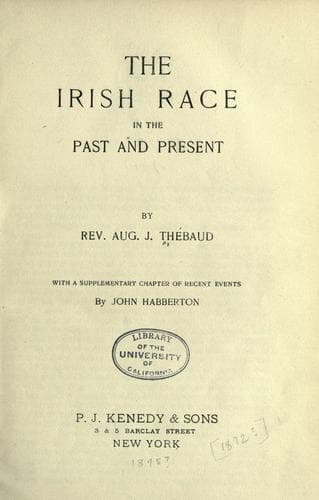
The Irish Race in the Past and the PresentThébaud, Augustus J.
History
The Irish Race in the Past and the Present
Thébaud, Augustus J.
Ireland -- History
The frozen and barren land which this people inhabited obliged
them from time immemorial to depend on the ocean for their
sustenance: first, by fishing; later on, by piracy. They soon
became expert navigators, though their ships were merely small
boats made of a few pieces of timber joined together, and
covered with the hide of the walrus and the seal.
It seems, from the Irish annals, that they belonged to two
distinct races of men: the Norwegians, fair-haired and of large
stature; the Danes dark, and of smaller size. Hence the Irish
distinguished the first, whom they called Finn Galls, from the
second, whom they named Dubh Galls. By no other European nation
was this distinction drawn, the Irish being more exact in
observing their foes.
It is the general opinion of modern writers that they belonged
to the Teutonic family. The Goths, a Teutonic tribe, dwelt for a
long period on the larger peninsula. But whether the Goths were
of the same race as the Norwegians or Danes is a question.
Certain it is that the various German nations which first
overwhelmed the Roman Empire bore many characteristics different
from those of the Danes and Norwegians, though the language of
all indicated, to a certain extent, a common origin.
The Swedes, the inhabitants of the eastern coast of Scania, do
not appear to have taken an important part in the Scandinavian
invasions; nor, indeed, have they ever been so fond of maritime
enterprises as the two other nations. Moreover, they were at
that time in bloody conflict with the Goths, and too busy at
home to think of foreign conquest.
For a long time the Scandinavian pirates seem to have confined
themselves to scouring their own seas, and plundering the coasts
as far as the gulfs of Finland and Bothnia. At length,
emboldened by success, they ventured out into the ocean,
attacked the nations of Western and Southern Europe, and in the
west colonized the frozen shores of the Shetland and Faroe
Islands, and soon after Iceland and Greenland.
For several centuries the harbors of Denmark and Norway became
the storehouses of all the riches of Europe, and a large trade
was carried on between those northern peninsulas and the various
islands of the Northern and Arctic Seas, even with the coast of
America, of which Greenland seems to form a part.
Those stern and mountainous countries and the restless ocean
which divides them were for the Scandinavian pirates what the
Mediterranean and the coasts of Spain and Africa had long before
been for the Phoenicians and Carthaginians. These peoples were
clearly destined to introduce among modern nations the spirit of
commerce and enterprise.
But here it is well to consider their religious and social state
from which nations chiefly derive their noble or ignoble
qualities. We shall find both made up of the rankest idolatry,
of cruel manners and revolting customs.
Public-domain text, read in full here on John Shaqi.
Reviews
Reviews
No reviews yet
Be the first to share your thoughts on this work.
Elsewhere in the archive
Join the Discussion
Join the discussion
Sign in to leave a comment or review.
Sign InorCreate an account