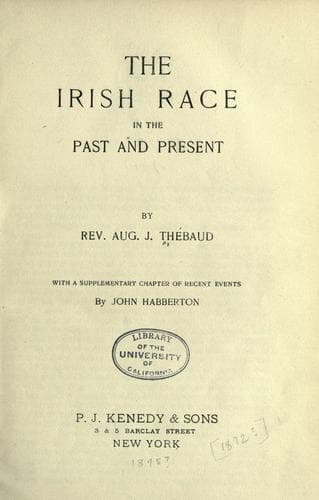
The Irish Race in the Past and the PresentThébaud, Augustus J.
History
The Irish Race in the Past and the Present
Thébaud, Augustus J.
Ireland -- History
Their system of worship, with its creed and rites, is much more
precise in character and better known to us than that of the
Celts. If we open the books which were written in Europe at the
time of the irruption of these Northmen, and the poems of those
savage tribes preserved to our own days, and comprised under the
name of Edda, besides the numerous sagas, or songs and ballads,
which we still possess, we find mention of three superior gods
and a number of inferior deities, which gave a peculiar
character to this Northern worship.
They were Thor, the god of the elements, of thunder chiefly;
Wodan or Odin, the god of war; and Frigga, the goddess of lust;
the long list of others it is unnecessary to give. Their
religion, therefore, consisted mainly: 1. In battling with the
elements, particularly on the sea, under the protection of Thor;
2. In slaying their enemies, or being themselves slain, as Odin
willed --the giving or receiving death being apparently the
great object of existence; 3. In abandoning themselves at the
time of victory to all the propensities of corrupt nature, which
they took to be the express will of Frigga manifested in their
unbridled passions.
Such was Scandinavian mythology in its reality.
Modern investigators, principally in Germany and France, find in
the Edda a complete system of cosmogony and of a religion almost
inspired, so beautiful do they make it. At least they have made
it appear as profound a philosophy as that of old Hindostan and
far-off Thibet. By grouping around those three great divinities,
which are supposed to be emblematical of the superior natural
forces, their numerous progeny, that of Odin especially,
together with an incredible number of malicious giants and good-
natured _ases_--a kind of fairy--any skilful theorist, gifted
with the requisite imagination, may extract from the whole an almost
perfect system of cosmogony and ethics. Then the disgusting legends
of the Edda and the sagas are straightway transformed into
interesting myths, offsprings of poetry and imagination, and
conveying to the mind a philosophy only less than sublime, derived,
as they say, from the religion of Zoroaster.
It is, as we said, in Germany and France chiefly that these
discoveries have been made. The English, a more sober people,
although of Scandinavian blood, do not set so high a value on
what is, in the literal sense, so low.
Pity that such pleasing speculations should be mere theoretical
bubbles, unable to retain their lightness and their vivid colors
in the rude atmosphere of the arctic regions, bursting at the
first breath of the north wind! How could sensible men, under
such a complicated system of religion and physics, account for
the uncouth pirates of the Baltic?
Public-domain text, read in full here on John Shaqi.
Reviews
Reviews
No reviews yet
Be the first to share your thoughts on this work.
Elsewhere in the archive
Join the Discussion
Join the discussion
Sign in to leave a comment or review.
Sign InorCreate an account