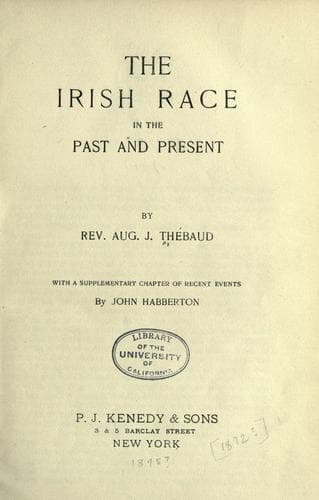
The Irish Race in the Past and the PresentThébaud, Augustus J.
History
The Irish Race in the Past and the Present
Thébaud, Augustus J.
Ireland -- History
No! The only true meaning of this Northern worship is conveyed
in the simple words of Adam of Bremen, when relating what still
existed in his own time. (_Descript. insularum Aquil._, lib. iv.)
He describes the solemn sacrifices of Upsala in Sweden thus:
"This is their sacrifice; of each and all animals they offer
nine heads of the male gender, by whose blood it is their custom
to appease the gods. The dead bodies of the victims are
suspended in a grove which surrounds the temple. The place is in
their eyes invested with such a sacred character that the trees
are believed to be divine on account of the blood and gore with
which they are besmeared. With the animals, dogs, horses, etc.,
they suspend likewise men; and a Christian of that country told
me that he had himself seen them with his own eyes mixed up
together in the grove. But the senseless rites which accompany
the sacrifice and the sprinkling of blood are so many, and of so
gross and immoral nature, that it is better not to speak of them."
We have here the naked truth, and no meaning whatever could be
attached to such ceremonies other than that of the rankest
idolatry. To complete the picture, it is proper to state that
Thor, Odin, and Frigga, were frightful idols, as represented in
the Upsala temple, and the small statues carried by the
Scandinavian sailors on their expeditions and set in the place
of honor on board their ships, were but diminutive copies of the
hideous originals. It is known, moreover, that Odin had existed
as a leader of some of their migrations, so that their idolatry
resolved itself into hero-worship.
Having spoken of their gods, we have only a word to add on their
belief in a future state, for every one is acquainted with their
brutal and shocking Walhalla. Yet, such as it was, admittance to
its halls could only be aspired to by the warriors and heroes,
the great among them; the common herd was not deemed worthy of
immortality. Thus aristocratic pride showed itself at the very
bottom of their religion.
Of their social state, their government, we know little. They
lived under a kind of rude monarchy, subject often to election,
when they chose the most savage and the bravest for their ruler.
But blood-relationship had little or nothing to do with their
system, so different from that of the Celts. The sons of a
chieftain could never form a sept, but at his death the eldest
replaced him; the younger brothers, deprived of their titles and
goods, were forced to separate and acquire a title to rank and
honor by piracy; and that right of primogeniture, which was the
primary cause of their sea invasions, stamped the feudal system
with one of its chief characteristics, a system which probably
originated with them. Some, however, entertain a contrary
opinion, and suppose that at the death of the father his
children shared his inheritance equally.
Public-domain text, read in full here on John Shaqi.
Reviews
Reviews
No reviews yet
Be the first to share your thoughts on this work.
Elsewhere in the archive
Join the Discussion
Join the discussion
Sign in to leave a comment or review.
Sign InorCreate an account