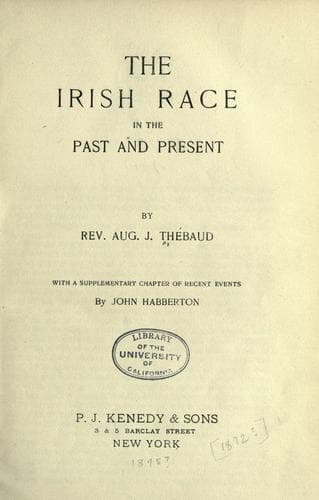
The Irish Race in the Past and the PresentThébaud, Augustus J.
History
The Irish Race in the Past and the Present
Thébaud, Augustus J.
Ireland -- History
Of their moral habits we may best judge by their religion. All
we know of their history seems to prove that with them might was
right, and outlawry the only penalty of their laws.
A man guilty of murder was compelled to quit the country, unless
his superior daring and the number of his friends and followers
enabled him, by more atrocious and wholesale murders, still to
become a great chieftain and even aspire to supreme power.
Iceland was colonized by outlaws from Norway; and the frequent
changes of dynasty in pagan times prove that among them, as
among barbarous tribes generally, brute force was the chief
source of law and authority.
That outlawry was not esteemed a stain on the character is
sufficiently demonstrated by the fact that the mere accident of
birth made outlaws of all the children of chieftains with the
exception of the eldest born; the necessity for the younger sons
abandoning their home and native country, and roaming the ocean
in search of plunder, being exactly equivalent, according to
their opinion and customs, to criminal outlawry of whatever
character. This, at least, many authors assert without
hesitation.
Their domestic habits were fit consequences of such a state of
society. There could exist no real tie of kindred, no filial or
brotherly affection among men living under such a social system.
The gratification of brutal passions and the most utter
selfishness constituted the rule for all; and even the fear of
an inexorable judge after death could not restrain them during
life, as might have been the case among other pagan nations,
since the hope of reaching their Walhalla depended for its
fulfilment on murder or suicide.
With their system of warfare we are better acquainted than with
any thing else belonging to them, as the main burden of their
songs was the recital of their barbarous expeditions. It is,
indeed, difficult for a modern reader to wade through the whole
of their Edda poems, or even their long sagas, so full is their
literature of unimaginable cruelties. Yet a general view of it
is necessary in order to understand the horror spread throughout
Europe by their inhuman warfare.
As soon as the warm breeze of an early spring thaws the ice on
his rivers and lakes, the Scandinavian Viking unfurls his sail,
fills his rude boat with provisions, and trusts himself to the
mercy of the waves. Should he be alone, and not powerful enough
to have a fleet at his command, he looks out for a single boat
of his own nation--there being no other in those seas. Urged by
a mutual impulse, the two crews attack each other at sight; the
sea reddens with blood; the savage bravery is equal on both
sides; accident alone can decide the contest. One of the crews
conquers by the death of all its opponents; the plunder is
transferred to the victorious boat; the cup of strong drink
passes round, and victory is crowned by drunkenness.
Public-domain text, read in full here on John Shaqi.
Reviews
Reviews
No reviews yet
Be the first to share your thoughts on this work.
Elsewhere in the archive
Join the Discussion
Join the discussion
Sign in to leave a comment or review.
Sign InorCreate an account