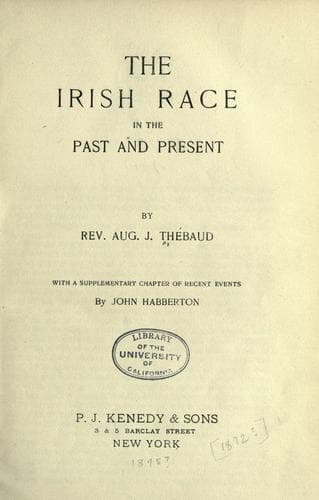
The Irish Race in the Past and the PresentThébaud, Augustus J.
History
The Irish Race in the Past and the Present
Thébaud, Augustus J.
Ireland -- History
We are already acquainted with the chief defect of their
political system, namely, its want of centralization. The Ard-
Righ was in fact but a nominal ruler, except in the small
province which acknowledged his chieftainship only. Throughout
the rest of Ireland the provincial kings were independent save
in name. Not only were they often reluctant to obey the Ard-Righ,
but they were not seldom at open war with him. Nor are we to
suppose that, at least in the case of a serious attack from
without, their patriotism overcame their private differences,
and made them combine together to show a common front against a
common foe. In a patriarchal state of government there is
scarcely any other form of patriotism than that of the
particular sept to which each individual belongs. All the ideas,
customs, prejudices, are opposed to united action.
Yet an invasion so formidable as that of the Scandinavian tribes
showed itself everywhere to be, would have required all the
energies and resources of the whole country united under one
powerful chief, particularly when it did not consist of one
single fearful irruption.
During two centuries large fleets of dingy, hide-bound barks
discharge on the shores of Erin their successive cargoes of
human fiends, bent on rapine and carnage, and altogether proof
against fear of even the most horrible death, since such death
was to them the entry to the eternal realms of their Walhalla.
But, at the period of which we speak, the terrible evil of a
want of centralization was greatly aggravated by a change
occurring in the line which held the supreme power in the island.
The vigorous rule of a long succession of princes belonging to
the northern Hy-Niall line gave way to the ascendency of the
southern branch of this great family; and the much more limited
patrimony and alliances of this new quasi-dynasty rendered its
personal power very inferior to that of the northern branch, and
consequently lessened the influence possessed by the ruling
family in past times. In Ireland the connections, more or less
numerous, by blood relationship with the great families, always
exercised a powerful influence over the body of the nation in
rendering it docile and amenable to the will of the Ard-Righ.
Mullingar, in West Meath, was the abode of the southern Hy-
Nialls, and Malachy of the Shannon, the first Ard-Righ of this
line, succeeded King Niall of Callan in 843. The Danes were
already in the country and had committed depredations. Their
first descent is mentioned by the Four Masters as taking place
at Rathlin on the coast of Antrim in the year 790.
Public-domain text, read in full here on John Shaqi.
Reviews
Reviews
No reviews yet
Be the first to share your thoughts on this work.
Elsewhere in the archive
Join the Discussion
Join the discussion
Sign in to leave a comment or review.
Sign InorCreate an account