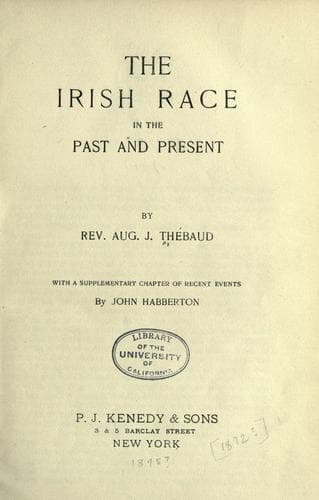
The Irish Race in the Past and the PresentThébaud, Augustus J.
History
The Irish Race in the Past and the Present
Thébaud, Augustus J.
Ireland -- History
But the country was soon aroused; and religious feelings, always
uppermost in the Irish heart, supplied the deficiencies of the
constitution of the state and the particularly unfavorable
circumstances of the period. The Danes, as usual, first attacked
the monasteries and churches, and this alone was enough to
kindle in the breasts of the people the spirit of resistance and
retaliation. Iona was laid waste in 797, and again in 801 and
805. "To save from the rapacity of the Danes," says Montalembert
in his Monks of the West, "a treasure which no pious liberality
could replace, the body of S. Columba was carried to Ireland.
And it is the unvarying tradition of Irish annals, that it was
deposited finally at Down, in an episcopal monastery, not far
from the eastern shore of the island, between the great
monastery of Bangor in the North, and Dublin the future capital
of Ireland, in the South."
Ireland was first assailed by the Danes on the north immediately
after they had gained possession of the Hebrides; but the coasts
of Germany, Belgium, and France had witnessed their attacks long
before. Religion was the first to suffer; and as the Island of
Saints was at the time of their descent covered with churches
and monasteries, the Scandinavian barbarians found in these a
rich harvest which induced them to return again and again. The
first expedition consisted of only a few boats and a small body
of men. Nevertheless, as their irruptions were unexpected, and
the people were unprepared for resistance, many holy edifices
suffered from these attacks, and a great number of priests and
monks were murdered.
We read that Armagh with its cathedral and monasteries was
plundered four times in one month, and in Bangor nine hundred
monks were slaughtered in a single day. The majority of the
inmates of those houses fled with their books and the relics of
their saints at the approach of the invaders, but, returning to
their desecrated homes after the departure of the pirates, gave
cause for those successive plunderings.
But the Irish did not always fly in dismay, as was the case in
England and France. A force was generally mustered in the
neighborhood to meet and repel the attack, and in numerous
instances the marauders were driven back with slaughter to their
ships.
Public-domain text, read in full here on John Shaqi.
Reviews
Reviews
No reviews yet
Be the first to share your thoughts on this work.
Elsewhere in the archive
Join the Discussion
Join the discussion
Sign in to leave a comment or review.
Sign InorCreate an account