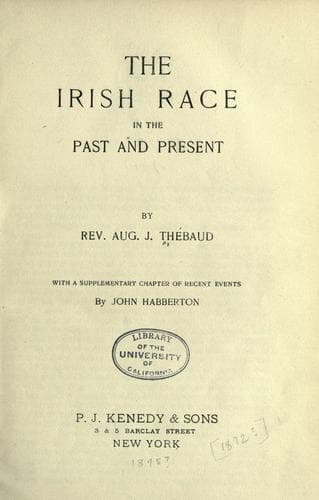
The Irish Race in the Past and the PresentThébaud, Augustus J.
History
The Irish Race in the Past and the Present
Thébaud, Augustus J.
Ireland -- History
Similar efforts were made about the same time by the Danes for
the lasting conquest of England, which succeeded, Sweyn having
been proclaimed king in 1013, and Canute the Great becoming its
undisputed ruler in 1017.
It is well known how the attempt failed in Erin, an army of
twenty-one thousand freebooters being completely defeated near
Dublin by Brian and his sons.
From that time the existence of the Scandinavian race on the
Irish soil was a precarious one; they were merely permitted to
occupy the sea-ports for the purpose of trade, and soon Irish
chieftains replaced their kings in Dublin, Limerick, Waterford,
and Cork.
The reader may be curious to learn, in conclusion, what signs
the Danes left of their long sojourn on the island. If we listen
to mere popular rumor, the country is still full of the ruins of
buildings occupied by them. The common people, in pointing out
to strangers the remains of edifices, fortifications, raths,
duns, even round-towers and churches, either more ancient or
more recent than the period of the Norse invasion, ascribe them
to the Danes. It is clear that two hundred years of devastations,
burnings, and horrors, have left a deep impression on the mind
of the Irish; and, as they cannot suppose that such powerful
enemies could have remained so long in their midst without
leaving wonderful traces of their passage, they often attribute
to them the construction of the very edifices which they
destroyed. The general accuracy of their traditions seems here
at fault. For there is no nation on earth so exact as the Irish
in keeping the true remembrance of facts of their past history.
Not long ago all Irish peasants were perfectly acquainted with
the whole history of their neighborhood; they could tell what
clans had succeeded each other, the exact spots where such a
party had been overthrown and such another victorious; every
village had its sure traditions printed on the minds of its
inhabitants, and, by consulting the annals of the nation, the
coincidence was often remarkable. How is it, therefore, that
they were so universally at fault with respect to the Danes?
A partial explanation has been given which is in itself a proof
of the tenacity of Irish memory. It is known that the Tuatha de
Danaan were not only skilful in medicine, in the working of
metals and in magic, but many buildings are generally attributed
to them by the best antiquarians; among others, the great mound
of New Grange, on the banks of the Boyne, which is still in
perfect preservation, although opened and pillaged by the Danes--
a work reminding the beholder of some Egyptian monument. The
coincidence of the name of the Tuatha de Danaan with that of the
Danes may have induced many of the illiterate Irish to adopt the
universal error into which they fell long ago, of attributing
most of the ancient monuments of their country to the Danes.
Public-domain text, read in full here on John Shaqi.
Reviews
Reviews
No reviews yet
Be the first to share your thoughts on this work.
Elsewhere in the archive
Join the Discussion
Join the discussion
Sign in to leave a comment or review.
Sign InorCreate an account