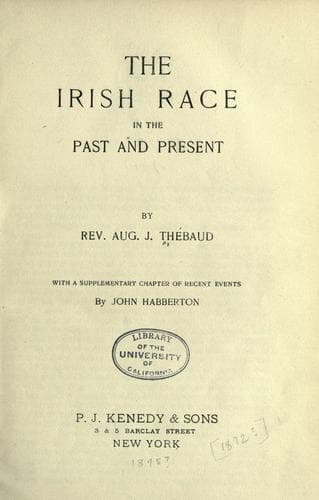
The Irish Race in the Past and the PresentThébaud, Augustus J.
History
The Irish Race in the Past and the Present
Thébaud, Augustus J.
Ireland -- History
This antipathy on both sides existed very early even in Church
affairs, the Christian natives being looked upon with a jealous
eye by the Christian Danes; so that, toward the middle of the
tenth century, the Danes of Dublin having succeeded in obtaining
a bishop of their own nation, they sent him to England to be
consecrated by Lanfranc, the Archbishop of Canterbury, and for a
long time the see of Dublin was placed under the jurisdiction of
Lanfranc's successors.
This grew into a serious difficulty for Ireland, as the capital
of Leinster began to be looked upon as depending, at least
spiritually, on England; and later on, at the time of the
invasion under Strongbow, the establishment of the English Pale
was considerably facilitated by such an arrangement, to which
Rome had consented only for the spiritual advantage of her
Scandinavian children in Ireland.
And the Irish were right in distrusting every thing foreign on
the soil, for, even after becoming Christians, the Danes could
not resist the temptation of making a last effort for the
subjugation of the country.
Hence arose their last general effort, which resulted in their
final overthrow at Clontarf. It does not enter into our purpose
to give the story of that great event, known in all its details
to the student of Irish history. It is not for us to trace the
various steps by which Brian Boru mounted to supreme power, and
superseded Malachi, to relate the many partial victories he had
already gained over the Northmen, nor to allude to his splendid
administration of the government, and the happiness of the Irish
under his sway.
But it is our duty to point out the persevering attempts of the
Scandinavian race, not only to keep its footing on Irish soil,
but to try anew to conquer what it had so often failed to
conquer. For, in describing their preparations for this last
attempt on a great scale, we but add another proof of that Irish
steadfastness which we have already had so many occasions to
admire.
In the chronicle of Adhemar, quoted by Lanigan from Labbe (Nova
Bibl., MSS., Tom. 2, p.177), it is said that "the Northmen came
at that time to Ireland, with an immense fleet, conveying even
their wives and children, with a view of extirpating the Irish
and occupying in their stead that very wealthy country in which
there were twelve cities, with extensive bishopries and a king."
Labbe thinks the Chronicle was written before the year 1031, so
that in his opinion the writer was a contemporary of the facts
he relates.
The Irish Annals state, on their side, that "the foreigners were
gathered from all the west of Europe, envoys having been
despatched into Norway, the Orkneys, the Baltic islands, so that
a great number of Vikings came from all parts of Scandinavia,
with their families, for the purpose of a permanent settlement."
Public-domain text, read in full here on John Shaqi.
Reviews
Reviews
No reviews yet
Be the first to share your thoughts on this work.
Elsewhere in the archive
Join the Discussion
Join the discussion
Sign in to leave a comment or review.
Sign InorCreate an account