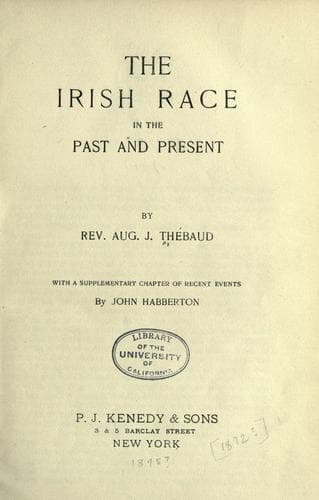
The Irish Race in the Past and the PresentThébaud, Augustus J.
History
The Irish Race in the Past and the Present
Thébaud, Augustus J.
Ireland -- History
The municipal system, which has won so much praise, was
scornfully abandoned by the Irish to the Danes of the sea port
towns, and they continued the agricultural life adapted to their
tastes. Towns and cities were not built in the interior till
much later by the English.
The clan territories continued to be governed as before. The
"Book of Rights" extended its enactments even to the Danish Pale;
and the Danes tried to convert it to their own advantage by
introducing into it false chapters. How the poem of the Gaels of
Ath Cliath first found a place in the "Book of Rights" is still
unknown to the best Irish antiquarians. John O'Donovan concludes
from a verse in it that it was composed in the tenth century,
after the conversion of the Danes of Dublin to Christianity. It
proves certainly that the Scandinavians in Ireland, like the
English of the Pale later on, had become attached to Erin and
Erin's customs--had, in fact, become. Irishmen, to all intents
and purposes. Not succeeding in making Northmen of the Irish,
they succumbed to the gentle influence of Irish manners and
religion.
As for the commercial spirit, the Irish could not be caught by
it, even when confronted by the spectacle of the wealth it
conferred on the "foreigners." It is stated openly in the annals
of the race that their greatest kings, both Malachi and Brian
Boru, did not utterly expel the Danes from the country, in order
that they might profit by the Scandinavian traders, and receive
through them the wines, silks, and other commodities, which the
latter imported from the continent of Europe.
The same is true of the sea-faring life. The Irish could never
be induced to adopt it as a profession, whatever may have been
their fondness for short voyages in their curraghs.
The only baneful effects which the Norse invasion exercised on
the Irish were: 1. The interruption of studies on the large,
even universal, scale on which, they had previously been
conducted; 2. The breaking up of the former constitution of the
monarchy, by compelling the several clans which were attacked by
the "foreigners" to act independently of the Ard-Righ, so that
from that time irresponsible power was divided among a much
greater number of chieftains.
But these unfortunate effects of the Norse irruptions affected
in no wise the Irish character, language, or institutions, which,
in fact, finally triumphed over the character, language, and
institutions of the pirates established among them for upward of
two centuries.
CHAPTER VI.
THE IRISH FREE CLANS AND ANGLO-NORMAN FEUDALISM.
The Danes were subdued, and the Irish at liberty to go on
weaving the threads of their history--though, in consequence of
the local wars, they had lost the concentrating power of the Ard-
Righ--when treachery in their own ranks opened up the way for a
far more serious attack from another branch of the great
Scandinavian family--the Anglo-Norman.
Public-domain text, read in full here on John Shaqi.
Reviews
Reviews
No reviews yet
Be the first to share your thoughts on this work.
Elsewhere in the archive
Join the Discussion
Join the discussion
Sign in to leave a comment or review.
Sign InorCreate an account