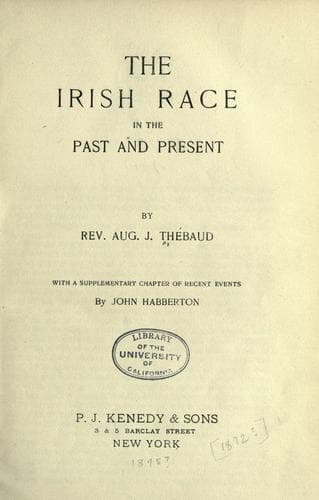
The Irish Race in the Past and the PresentThébaud, Augustus J.
History
The Irish Race in the Past and the Present
Thébaud, Augustus J.
Ireland -- History
The manners of the people had been left unchanged; the clan
system had not been altered in the least; it had stood the test
of previous revolutions; now it was to be confronted by a new
system which had just conquered Europe, and spread itself round
about the apparently doomed island. Of all places it had taken
deep root in England, where it was destined to survive its
destruction elsewhere in the convulsions of our modern history.
That system, then in full vigor, was feudalism.
In order rightly to understand and form a correct judgment on
the question, and its mighty issues, we must state briefly what
the chief characteristics of feudalism were in those countries
where it flourished.
The feudal system proceeded on the principle that landed
property was all derived from the king, as the captain of a
conquering army; that it had been distributed by him among his
followers on certain conditions, and that it was liable to be
forfeited if those conditions were not fulfilled.
The feudal system, moreover, politically considered, supposed
the principle that all civil and political rights were derived
from the possession of land; that those who possessed no land
could possess neither civil nor political rights--were, in fact,
not men, but villeins.
Consequently, it reduced nations to a small number of landowners,
enjoying all the privileges of citizenship; the masses,
deprived of all rights, having no share in the government, no
opportunity of rising in the social scale, were forever
condemned to villeinage or serfdom.
Feudalism, in our opinion, came first from Scandinavia. The
majority of writers derive it from Germany. The question of its
origin is too extensive to be included within our present limits,
and indeed is unnecessary, as we deal principally with the fact
and not with its history.
When the sea-rover had conquered the boat of an enemy, or
destroyed a village, he distributed the spoils among his crew.
Every thing was handed over to his followers in the form of a
gift, and in return these latter were bound to serve him with
the greatest ardor and devotedness. In course of time the idea
of settling down on some territory which they had devastated and
depopulated, presented itself to the minds of the rovers. The
sea-kong did by the land what he had been accustomed to do by
the plunder: he parcelled it out among his faithful followers--
fideles--giving to each his share of the territory. This was
called feoh by the Anglo-Saxons, who were the first to carry out
the system on British soil, as Dr. Lingard shows. Thus the word
fief was coined, which in due time took its place in all the
languages of Europe.
Public-domain text, read in full here on John Shaqi.
Reviews
Reviews
No reviews yet
Be the first to share your thoughts on this work.
Elsewhere in the archive
Join the Discussion
Join the discussion
Sign in to leave a comment or review.
Sign InorCreate an account