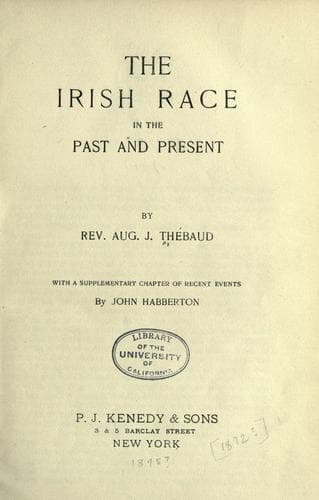
The Irish Race in the Past and the PresentThébaud, Augustus J.
History
The Irish Race in the Past and the Present
Thébaud, Augustus J.
Ireland -- History
So wide-reaching and comprehensive was the plan of the invaders
from the beginning that they felt confident of holding
possession of Ireland forever; and to effect this they must
certainly have intended to destroy or drive out the native race,
or at best to make slaves of as many of them as they chose to
keep. Thus they had prophecies manufactured for the purpose, and
Cambrensis, in his second book, chapter xxxiii., says
confidently: "Prophecies promise a full victory to the English
people. . . . and that the island of Hibernia shall be subjected
and fortified with castles--literally incastellated,
incastellatam--throughout from sea to sea."
Meanwhile, together with the building of castles, the partition
of the territory was being carried out. The ten great lords,
among whom, according to Sir John Davies, Henry II. had
cantonized Ireland, saw the necessity of giving a part of their
large estates to their followers that so they might occupy the
whole. McGeohegan compiles from Ware the best view of this very
interesting and comparatively unexplored subject. Curious
details are found there, showing that, with the exception of
Ulster, not only the geography, but even the most minute
topography of the country, had been well studied by those feudal
chieftains. Their characteristic love for system runs all
through these transactions.
But the Irish had now seen enough. The whole country was in a
blaze. That kind of guerilla war peculiar to the Celtic clans
began. The newly built castles were attacked and often captured
and destroyed. Strongbow was shut up and besieged in Water- ford,
which fell into the hands of the Danes. The latter sided
everywhere with the Irish. Limerick changed hands several times,
until Donnall O'Brian, who was left in possession, set fire to
it rather than see it fall again into the hands of the invaders.
In Meath, where the numerous castles of De Lacy were situated, a
war to the knife was being waged. O'Melachlin first tried
persuasion, but in conference with De Lacy he dared inveigh
loudly against the King of England, and, as his words must have
expressed the feelings of the great majority of the people, we
give them:
"Notwithstanding his promise of supporting me in the possession
of my wealth and dignities, he has sent robbers to invade my
patrimony. Avaricious and sparing of his own possessions, he is
lavish of those of others, and thus enriches libertines and
profligates who have consumed the patrimony of their fathers in
debauchery."
This manly protest was answered by the stroke of a dagger from
the hand of Raymond Legros, and, after being beheaded,
0'Melachlin was buried feet upward as a rebel.
The monarch himself, Roderic O'Connor, finally appeared on the
scene, beat the English at Thurles, and, marching into Meath,
laid the country waste.
Public-domain text, read in full here on John Shaqi.
Reviews
Reviews
No reviews yet
Be the first to share your thoughts on this work.
Elsewhere in the archive
Join the Discussion
Join the discussion
Sign in to leave a comment or review.
Sign InorCreate an account