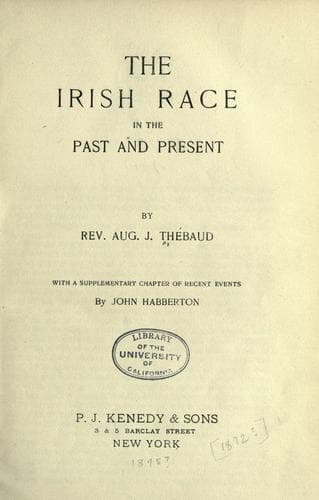
The Irish Race in the Past and the PresentThébaud, Augustus J.
History
The Irish Race in the Past and the Present
Thébaud, Augustus J.
Ireland -- History
The English claimed the whole island as their own. They were, in
fact, masters only of the portion occupied by their troops; the
remainder was, therefore, to be conquered. And if in Desmond,
where the whole strength of the English first fell, they
possessed only a little more than one-fourth of the soil, what
was the case in the rest of the island, the most of which had
not yet seen them?
Long years of war would evidently be required to subdue it, and
the systematic mind of the conquerors immediately set about
devising the best means for the attainment of their purpose. The
lessons gathered from their continental experience suggested
these means immediately; they saw that by covering the country
with feudal castles they could in the end conquer the most
stubborn nation. A thorough revolution was intended. The two
systems were so entirely antagonistic to each other that the
success of the Norman project involved a change of land tenure,
laws, customs, dress--every thing. Even the music of the bards
was to be silenced, the poetry of the files to be abolished, the
pedigrees of families to be discontinued, the very games of the
people to be interrupted and forbidden. A vast number of castles
was necessary. The project was a fearful one, cruel, barbarous,
worthy of pagan antiquity. It was undertaken with a kind of
ferocious alacrity, and in a short time it appeared near
realization. But in the long run it failed, and four hundred
years later, under the eighth Henry, it was as far from
completion as the day on which the second Henry left the island
in 1171.
To show the importance which the invaders attached to their
system, and the ardor with which they set about putting it in
practice, we have only to extract a few passages from the old
annals of the islands; they are wonderfully expressive in their
simplicity:
"A.D. 1176. The English were driven from Limerick by Donnall
O'Brian. An English castle was in process of erection at Kells."-
-(Four Masters.)
"A.D. 1178. The English built and fortified a castle at Kenlis,
the key of those parts of Meath, against the incursions of the
Ulster men."--(Ware's Antiquities.)
"A.D. 1180. Hugh De Lacy planted several colonies in Meath, and
fortified the country with many castles, for the defence and
security of the English."--(Ibid.)
Such enumerations might be prolonged indefinitely; we conclude
with the following entry taken from the Four Masters:
"A.D. 1186. Hugh De Lacy, the profaner and destroyer of many
churches, Lord of the English of Meath (the Irish cannot call
him their lord), Breffni, and Oirghialla, he who had conquered
the greater part of Ireland for the English, and of whose
English castles all Meath, from the Shannon to the sea, was full,
after having finished the castle of Der Magh, set out
accompanied by three Englishmen to visit it . . . . One of the
men of Tebtha, a youth named O'Miadhaigh, approached him, and
with an axe severed his head from his body."
Public-domain text, read in full here on John Shaqi.
Reviews
Reviews
No reviews yet
Be the first to share your thoughts on this work.
Elsewhere in the archive
Join the Discussion
Join the discussion
Sign in to leave a comment or review.
Sign InorCreate an account