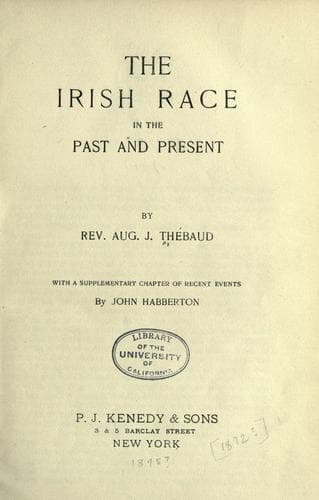
The Irish Race in the Past and the PresentThébaud, Augustus J.
History
The Irish Race in the Past and the Present
Thébaud, Augustus J.
Ireland -- History
Here would be the proper place to speak of the Brehon law, which
remained thus in antagonism to feudal customs for several
centuries. Up to recently, however, only vague notions could be
given of that code. But at this moment antiquarians are revising
and studying it preparatory to publishing the "Senchus Mor" in
which the Irish law is contained. It is known that it existed
previous to the conversion of Ireland to Christianity, and that
the laws of tanistry and of gavelkind, the customs of gossipred
and of fostering, were of pagan origin. Patrick revised the code
and corrected what could not coincide with the Christian
religion. He also introduced into the island many principles of
the Roman civil and canon law, which, without destroying the
peculiarities natural to the Irish character, invested their
code with a more modern and Christian aspect.
Edmund Campian, who afterward died a martyr under Elizabeth,
says, in his "Account of Ireland," written in May, 1571: "They
(the Irish) speak Latin like a vulgar language, learned in their
common schools of leechcraft and law, whereat they begin
children, and hold on sixteen or twenty years, conning by rote
the aphorisms of Hippocrates, and the Civil Institutes, and a
few other parings of these two faculties. I have seen them where
they kept school, ten in some one chamber, grovelling upon
couches of straw, their books at their noses, themselves lying
prostrate, and so to chant out their lessons by piecemeal, being
the most part lusty fellows of twenty-five years and upward."
It was then after studies of from sixteen to twenty years that
the Brehon judge--the great one of a whole sept, or the inferior
one of a single noble family--sat at certain appointed times, in
the open air, on a hill generally, having for his seat clods of
earth, to decide on the various subjects of difference among
neighbors.
Sir James Ware remarks that they were not acquainted with the
laws of England. He might have better said, they preferred their
own, as not coming from cold and pagan Scandinavia, but from the
warm south, the greatest of human law-givers, the jurisconsults
of Old Rome, and the holy expounders of the laws of Christian
Rome.
What were those laws of England of which Ware speaks? There is
no question here of the common law which came into use in times
posterior to Henry II., and which the English derived chiefly
from the Christian civil and canon law; but of those feudal
enactments, which the Anglo-Normans endeavored to introduce into
Ireland, for the purpose of supplanting the old law and customs
of the natives.
There was, first, the law of territory, if we may so call it, by
which the supreme ruler became really owner of the integral soil,
which he distributed among his great vassals, to be
redistributed by them among inferior vassals.
Public-domain text, read in full here on John Shaqi.
Reviews
Reviews
No reviews yet
Be the first to share your thoughts on this work.
Elsewhere in the archive
Join the Discussion
Join the discussion
Sign in to leave a comment or review.
Sign InorCreate an account