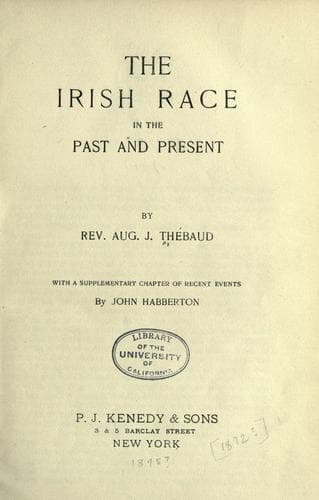
The Irish Race in the Past and the PresentThébaud, Augustus J.
History
The Irish Race in the Past and the Present
Thébaud, Augustus J.
Ireland -- History
There was the law of primogeniture, which even to this day
obtains in England, and has brought about in that country since
the days of William the Conqueror, and in Ireland since the
English "plantations" of the sixteenth and seventeenth centuries,
the state of things now so well known to Europe.
There was also the long list of feudal conditions to be observed,
by the fulfilment of which the great barons and their followers
held their lands. For their tenure was liable to homage and
fealty, as understood in the feudal sense, to wardships and
impediments to marriage, to fines for alienations, to what
English legists call primer seizins, rents, reliefs, escheats,
and, finally, forfeitures; this last was at all times more
strictly observed in England than in any other feudal country,
and by its enactments so many noble families have, in the course
of ages, been reduced to beggary, and their chiefs often brought
to the block. English history is filled with such cases.
The law of wardship, by which no minor, heir, or heiress could
have other guardian than the suzerain, and could not marry
without his consent, was at all times a great source of wealth
to the royal exchequer, and a correspondingly heavy tribute laid
on the vassal. So profitable did the English kings find this law,
that they speedily introduced it into Church affairs, every
bishop's see or monastery being considered, at the death of the
incumbent, as a minor, a ward, to be taken care of by the
sovereign, who enjoyed the revenues without bothering himself
particularly with the charges.
There were, finally, the hunting laws, which forbade any man to
hunt or hawk even on his own estate.
Such were the laws of England, which Sir James Ware complains
the Irish did not know.
In signing the treaty of Windsor, the English king had
apparently recognized in the person of Roderic O'Connor, and in
the Irish through him, the chief rights of sovereignty over the
whole island, except Leinster and, perhaps, Meath. But, at the
same time, a passage or two in the treaty concealed a meaning
certainly unperceived by the Irish, but fraught with mischief
and misfortune to their country.
First, Roderic O'Connor acknowledged himself and his successors
as liegemen of the kings of England; in a second place, the
privileges conceded to the Irish were to continue only so long
as they remained faithful to their oath of allegiance. We see
here the same confusion of ideas, which we remarked on the
meaning given to the word homage by either party. The natives of
the island understood to be liegemen and under oath in a sense
conformable to their usual ideas of subordination; the English
invested those words with the feudal meaning.
All the calamities of the four following centuries, and,
consequently, all the horrors of the times subsequent to the
Protestant Reformation, were to be the penalty of that
misunderstanding.
Public-domain text, read in full here on John Shaqi.
Reviews
Reviews
No reviews yet
Be the first to share your thoughts on this work.
Elsewhere in the archive
Join the Discussion
Join the discussion
Sign in to leave a comment or review.
Sign InorCreate an account