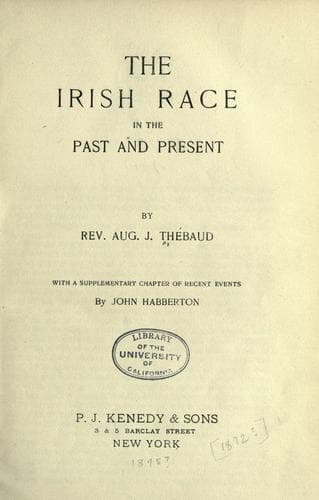
The Irish Race in the Past and the PresentThébaud, Augustus J.
History
The Irish Race in the Past and the Present
Thébaud, Augustus J.
Ireland -- History
Let us picture to ourselves two races of men so different as the
Milesian Celts on the one side, and the Scandinavian Norman
French on the other, having concluded such a treaty as that of
Windsor, each side resolved to push its own interpretation to
the bitter end.
The English are in possession of a territory clearly enough
defined, but they are ever on the alert to seize any opportunity
of a real or pretended violation of it, in order to extend their
limits and subjugate the whole island. Yet they are bound to
allow the Brehon Irish to live in their midst, governed by their
own customs and laws. Moreover, they acknowledge that the former
great Irish lords of the very country which they occupy are not
mere Irish, but of noble blood; for, from the beginning, the
English recognized five families of the country, known as the
"five bloods," as pure and noble, in theory at least.
The Irish without the Pale are acknowledged as perfectly
independent, completely beyond English control, with their own
magistrates and laws, even that of war; subject only to tribute.
But, at the same time, this independence is rendered absolutely
insecure by the imposition of conditions, whose meaning is well
known and perfectly understood in all the countries conquered by
the Scandinavians, but utterly beyond the comprehension of the
Irish.
The consequence is clear: war began with the conclusion of the
treaty--a war which raged for four centuries, until a new and
more powerful incentive to slaughter and desolation showed
itself in the Reformation, ushered in by Henry VIII.
First came a general rebellion. This is the word used by
Ware, when John, a boy of twelve years of age, was dispatched by
his father Henry, with the title of Lord of Ireland, to receive
the submission of various Irish lords at Waterford, where he
landed. "The young English gentlemen," says Cambrensis, who was
a witness of the scene, "used the Irish chieftains with scorn,
because," as he says, "their demeanor was rude and barbarous."
The Irish naturally resented this treatment from a lad, as they
would have resented it from his father; and they retired in
wrath to take up arms and raise the whole land to "rebellion."
This solemn protest was not without effect in Europe. At the
beginning of the reign of Richard I., Clement III., on
appointing, by the king's request, William de Longchamps,
Bishop of Ely, as his legate in England, Wales, and Ireland,
took good care to limit the authority of this prelate to those
parts of Ireland which lay under the jurisdiction of the Earl
of Moreton-- that is, of John, brother to Richard. He had power
to exercise his jurisdiction "in Anglia,, Wallia, et illis
Hiberniae partibus in quibus Joannes Moretonii Comes potestatem
habet et dominium."--(Matth. Paris.) It would seem, then, that
Clement III. knew nothing of the bull of Adrian IV.
Public-domain text, read in full here on John Shaqi.
Reviews
Reviews
No reviews yet
Be the first to share your thoughts on this work.
Elsewhere in the archive
Join the Discussion
Join the discussion
Sign in to leave a comment or review.
Sign InorCreate an account