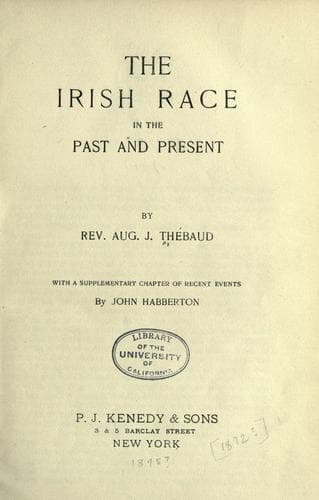
The Irish Race in the Past and the PresentThébaud, Augustus J.
History
The Irish Race in the Past and the Present
Thébaud, Augustus J.
Ireland -- History
We have not been able to ascertain the precise epoch in which
the first Irish Parliament was convened; indeed, to this day, it
seems a debated question. The general belief, however, ascribes
it to King John. The first mention of it by Ware is under the
year 1333, as late as Edward III., more than one hundred and
fifty years after the Conquest. But the need of stringent rules
to keep the Irish at bay, and prevent the English from
"degenerating," became so urgent that, in 1367, the famous
Parliament met at Kilkenny, and enacted the bill known as the
"Statutes of Kilkenny," in which the matter was fully elaborated,
and a new order of things set on foot in Ireland.
The Irish could recognize no other Parliament than their ancient
Feis; and, these having been discontinued for several centuries,
they showed their appreciation of the new English institution in
the manner described by Ware under the year 1413: "On the 11th
of the calends of February, the morrow after St. Matthias day, a
Parliament began at Dublin, and continued for the space of
fifteen days; in which time the Irish burned all that stood in
their way, as their usual custom was in times of other
Parliaments."
The reader who is acquainted with the enactments which go by the
name of the "Statutes of Kilkenny" will scarcely wonder at this
mode of proceeding.
Neither at that period, nor later on save once under Henry VIII.,
was the Irish race represented in those assemblies. In the
reign of Edward III. no Irish native nor old English resident
assisted at the Parliament of Kilkenny, but only Englishmen
newly arrived; for all its acts were directed against the Irish
and the degenerate English--against the latter particularly. How
the members composing these Parliaments were elected at that
time we do not know; but they were not summoned from more than
twelve counties, which number, first established by King John,
gradually dwindled, until, in the reign of Henry VII., it was
reduced to four, so that the Irish Parliament came to be
composed of a few men, and those few representatives of purely
English interests.
A true history of the times would demand an examination of the
various enactments made by these so-called Irish Parliaments, as
setting forth more distinctly than any thing else could do the
points at variance between the two nations. Our space, however,
and indeed our purpose, forbids this. In order to put the reader
in possession of at least an idea of the difficulties on either
side, we add a few extracts from the very famous "Statutes of
Kilkenny."
Public-domain text, read in full here on John Shaqi.
Reviews
Reviews
No reviews yet
Be the first to share your thoughts on this work.
Elsewhere in the archive
Join the Discussion
Join the discussion
Sign in to leave a comment or review.
Sign InorCreate an account