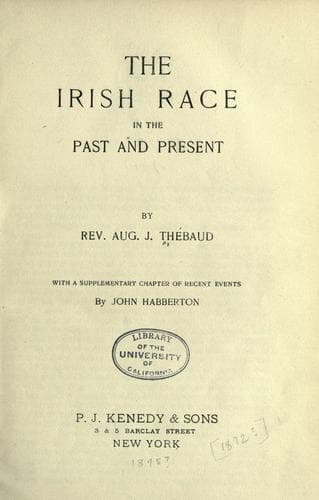
The Irish Race in the Past and the PresentThébaud, Augustus J.
History
The Irish Race in the Past and the Present
Thébaud, Augustus J.
Ireland -- History
The preamble sets forth "that already the English in Ireland
were mere Irish in their language, names, apparel, and their
manner of living, and had rejected the English laws and
submitted to the Irish, with whom they had many marriages and
alliances, which tended to the utter ruin and destruction of the
commonwealth." And then the Statutes go on to enact --we cull
from various chapters: "The English cannot any more make peace
or war with the Irish without special warrant; it is made penal
to the English to permit the Irish to send their cattle to graze
upon their land; the Irish could not be presented by the English
to any ecclesiastical benefice; they--the Irish--could not be
received into any monasteries or religious houses; the English
could not entertain any of their bards, or poets, or shanachies,
" etc.
This extraordinary legislation proves beyond any amount of facts
to what degree the posterity of the first Norman invaders of
Ireland had adopted Irish customs, and made themselves one with
the natives.
The Irish, therefore, had, in this instance, morally conquered
their enemies, and feudalism was defeated. Another example was
given of the invariable invasions of the island. The enemy,
however successful at the beginning, was compelled finally to
give way to the force of resistance in this people; and the time-
honored customs of an ancient race survived all attempts at
violent foreign innovations. The posterity of those proud nobles,
who, with Giraldus Cambrensis, had found nothing but what was
contemptible in this nation, so strange to their eyes, who
looked upon them as an easy victim to be despoiled of their land,
and that land to be occupied by them, that posterity adopted,
within, comparatively speaking, a few years, the life and
manners of the mere Irish in their entirety. Feudalism they
renounced for the clan. Each of the great English families that
first landed in the island had formed a new sept, and the clans
of the Geraldines, De Courcys, and others, were admitted into
full copartnership with the old Milesian septs. This the two
great families of the Burkes in Connaught called their chiefs
McWilllams Either and McWilliams Oughter. The Berminghams bad
become McYoris; the Dixons, McJordans; the Mangles, McCostellos.
Other old English families were called McHubbard, McDavid, etc.;
one of the Geraldine septs was known as McMorice, another as
McGibbon; the chief of Dunboyne's house became McPheris.
Meanwhile, "it was manifest," says Sir John Davies, "that those
who had the government of Ireland under the crown of England
intended to make a perpetual separation and enmity between the
English settled in Ireland and the Irish, in the expectation
that the English should in the end root out the Irish."
Public-domain text, read in full here on John Shaqi.
Reviews
Reviews
No reviews yet
Be the first to share your thoughts on this work.
Elsewhere in the archive
Join the Discussion
Join the discussion
Sign in to leave a comment or review.
Sign InorCreate an account