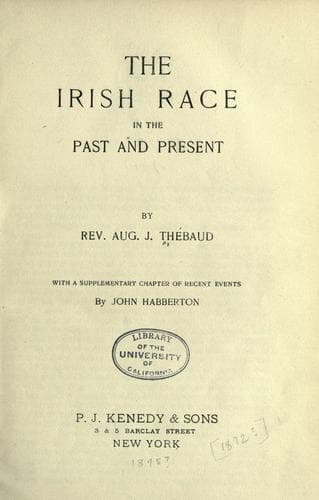
The Irish Race in the Past and the PresentThébaud, Augustus J.
History
The Irish Race in the Past and the Present
Thébaud, Augustus J.
Ireland -- History
If the Irish were right in holding steadfast to the line of their
traditional studies, in rejecting the city life and commercial
spirit of the Danes, in opposing Anglo-Norman feudalism, and,
finally, in not accepting the more than doubtful advantages flowing
from the literary revival of the fifteenth century; if, in all
this, they did not oppose true progress, but merely wished to
advance in the peculiar path opened up to them by the Christianity
which they had received more fully, with more earnestness, and
with a view to a greater development of the supernatural idea,
than any other European nation--then, beyond all other modes, did
they display their strength of will and their undying national
vitality in their resistance to Protestantism--a resistance which
has been called opposition to progress, but the success of which
to-day proves beyond question that they were right.
It was, the reader may remark, a resistance to the whole of
Northern Europe, wherein their island was included. For, the
whole of Northern Europe rebelled against the Church at the
beginning of the sixteenth century, to enter upon a new road of
progress and civilization, as it has been called, ending finally
in the frightful abyss of materialism and atheism which now gapes
under the feet of modern nations--an abyss in whose yawning womb
nullus ordo, sed sempiternus horror habitat. The end of that
progress is now plain enough: political and social convulsions,
without any other probable issue than final anarchy, unless nations
consent at last to retrace their steps and reorganize Christendom.
But this was not apparent to the eyes of ordinary thinkers in the
sixteenth and seventeenth centuries. Only a few great minds saw
the logical consequences of the premises laid down by Protestantism,
and predicted something of what we now see.
The Irish was the only northern nation which, to a man, opposed
the terrible delusion, and, at the cost of all that is dear, waged
against it a relentless war.
"To a man;" for, in spite of all the wiles of Henry VIII., who
brought every resource of his political talent into play, in order
to win over to his side the great chieftains of the nation--in
spite of all the efforts of Elizabeth, who either tried to overcome
their resistance by her numerous armies, or, by the allurements
of her court, strove her best, like her father, to woo to her
allegiance the great leaders of the chief clans, particularly O'Neill
of Tyrone--at the end of her long reign, after nearly a hundred
years of Protestantism, only sixty Irishmen of all classes had
received the new religion.
Public-domain text, read in full here on John Shaqi.
Reviews
Reviews
No reviews yet
Be the first to share your thoughts on this work.
Join the Discussion
Join the discussion
Sign in to leave a comment or review.
Sign InorCreate an account