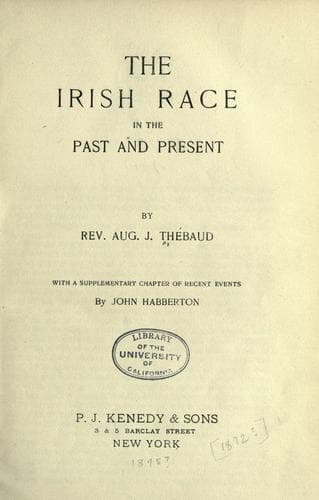
The Irish Race in the Past and the PresentThébaud, Augustus J.
History
The Irish Race in the Past and the Present
Thébaud, Augustus J.
Ireland -- History
It is known also that the posterity of the first crusaders in
Palestine formed a hybrid race, which, weakened by the influence
of the luxurious habits of Eastern countries, became corrupt,
and under the name of Pulani practised a feeble Christianity,
unfit to cope with the vigorous fanaticism of the Mussulman.
Many Europeans came back from those wars wavering in faith, and
no one knows how many with faith entirely lost.
It is not, therefore, too much to suppose that the Oriental
errors which suddenly burst forth at this time in Western Europe
followed in the wake of the returning pilgrims, and it is highly
probable, if not absolutely certain, that, had there been no
Crusades, Manicheism and the secret societies born of it would
never have been known in Italy and France. Hence, one of the
first and greatest champions of the Church in controversy with
the Albigenses - Peter the Venerable, Abbot of Cluny - at the
very beginning of the heresy, found no better means of opposing
the new errors than attacking every thing coming from the East.
Thus, he wrote his long treatises against the Talmud and the
Koran, so much had the Crusades already contributed to
introducing into Western Europe the seeds of Asiatic errors. All
historians agree in giving an Eastern origin to the Paulicians,
Bulgarians, Albigenses, and others of those times.
Manicheism indeed had infested Europe long before. Some Roman
emperors had published severe edicts against it. In the fifth
century, the heresy still flourished in Italy and Africa, St.
Augustine himself being an adept for several years, and by his
writings he has made us acquainted with its strongest supporters
in his day. He was followed, in his attacks on it, by a great
number of Fathers, both Greek and Latin.
But after the barbarian invasions we hear no more of the
Manichees for upward of five hundred years. The West had
entirely forgotten them. Arianism and Manicheism had apparently
perished together. The tenth century is called a period of
darkness and ignorance; it at least possessed the advantage of
being free from heresy; the dogmas of the Church were
unhesitatingly and universally accepted. Western Europe, though
cut up by the new-born feudalism into a thousand fragments, was
at least one in faith, until that great and powerful union
having, in an outburst of enthusiasm, produced the Crusades, we
suddenly find Eastern theories and immoralities invading the
countries most faithful to the Church.
Public-domain text, read in full here on John Shaqi.
Reviews
Reviews
No reviews yet
Be the first to share your thoughts on this work.
Elsewhere in the archive
Join the Discussion
Join the discussion
Sign in to leave a comment or review.
Sign InorCreate an account