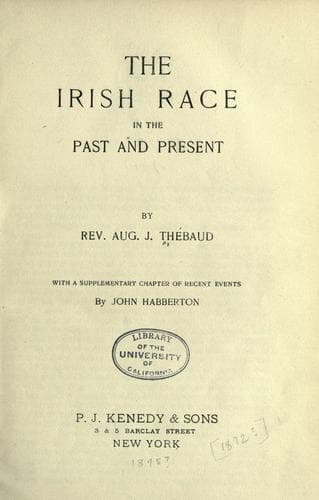
The Irish Race in the Past and the PresentThébaud, Augustus J.
History
The Irish Race in the Past and the Present
Thébaud, Augustus J.
Ireland -- History
Among such results is one which has not met with all the
attention it deserves. Historians speak at length of the many
and wide-spread heresies which infected Europe during the middle
ages; but their Eastern origin has not been thoroughly
investigated, and we have no doubt that, if it had been, many of
them would be found to have come with a returning wave of the
Crusades.
All these errors bear at the outset a very Oriental appearance.
Paulicians, Petrobrusians, Albigensians, and kindred sects,
all started from the principle of dualism, and even at the
time were openly accused of Manicheistic ideas. They all
involved more or less immoral principles, and rejected, or at
least strove to weaken, the commonly-received ideas upon which
society, civil and religious, is founded. Had they succeeded in
spreading their errors through Europe, it is possible that the
invasion would have been more fatal in its consequences than
that of Islamism itself. And, even in their failure, they left
among European societies the germ of secret associations which
have existed from that time down, and which in our days have
burst forth undisguised to terrify nations, and cause them to
dread the coming of the last days.
To an attentive observer it is clear that the heresies of the
twelfth, thirteenth, and fourteenth centuries resemble more the
errors of our days than the Protestantism which intervened.
Luther's first principles, if carried to their legitimate
conclusion, would have inaugurated the socialism and communism
of modern times; but he shrank from the consequences of his own
doctrines, and the necessity of his standing well with the
German princes caused him, during the War of the Peasants,
almost to retract his first utterances and take his stand
midway between Catholic principles and the thorough nihilism of
later times. It is known that in the after-part of his life he
endeavored to repair the ruins of every dogma, social and
religious, which he at first had tried to subvert and destroy.
The Manicheism of the middle ages was certainly not of so
scientific and elaborate a nature as modern socialism; but it
would have been productive of like evil results to society had
it not been crushed down by the united power of the Church and
the state. If it had been successful, it is impossible to
imagine what would have become of Europe.
Of its Eastern origin historians say little. We know, however,
that, after a residence in the East, the most pious Christians
grew lukewarm and less firm in their opposition to the dangerous
errors then prevalent in Asia. Tournefort remarked this in his
own time, during the reign of Louis XIV.
Public-domain text, read in full here on John Shaqi.
Reviews
Reviews
No reviews yet
Be the first to share your thoughts on this work.
Elsewhere in the archive
Join the Discussion
Join the discussion
Sign in to leave a comment or review.
Sign InorCreate an account