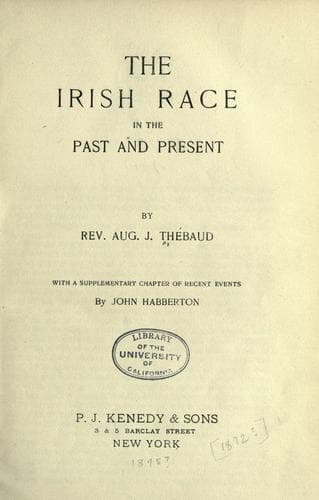
The Irish Race in the Past and the PresentThébaud, Augustus J.
History
The Irish Race in the Past and the Present
Thébaud, Augustus J.
Ireland -- History
It is clear from many things related by Ware in his
"Antiquities" that the Vicar of Christ, unable to follow freely
his inclinations with respect to the filling of the sees of Erin,
and obliged to appoint to bishoprics, at least in many parts of
the island, only men of English birth, selected for that purpose
members of the various religious orders then existing. Instead
of granting episcopal jurisdiction to the feudal nominees of the
court, when unworthy, Rome appointed a Franciscan, or a
Dominican, a member of some religious community, who was born in
England, but at least more independent of the court, of greater
sympathy with the people, less swayed by worldly and selfish
motives, and consequently readier to obey the mandates of Rome,
which were always on the side of justice and morality. Thus we
find that in the whole history of Ireland, as a general rule,
the bishops chosen from religious orders were acceptable to the
people, and true to their duty.
Such a man certainly was Richard Ledred, a Minorite, born in
London, whom the Pope made Bishop of Ossory. But on that very
account he incurred the hatred of many English officials, and
even of worldly prelates, among whom Alexander Bicknor,
Archbishop of Dublin, was the most conspicuous. Bieknor was not
only archbishop, but had been appointed Lord Justice of Ireland
by the king, and later on Lord Deputy; later still he was
dispatched by the English Parliament as ambassador to France.
"It had been well," says F. Brenan, "for the archbishop himself,
and for those immediately under his jurisdiction, had he
abstained from mixing himself up with the state affairs of those
times. Ambition formed no inferior trait in the character of
Alexander, even long before he had been exalted to a high
dignity in the Church. He advanced rapidly into power, stepping
from one office into another, until at length he found himself
in the midst of the labyrinth, without being able to make his
way, unless by means of guides as inexperienced as they were
treacherous. It was by causes such as these that he brought
himself into serious difficulties, not only with the Archbishop
of Armagh, on account of the primacy, but also with his own
suffragans, and particularly with the Bishop of Ossory."
Under these circumstances it was that the prelate last mentioned,
on visiting his diocese, found unmistakable signs of the spread
of heresy among his flock. His diocese at that time formed a
part of the English Pale, and Kilkenny, where he had his
cathedral, was often the seat of Parliament.
Public-domain text, read in full here on John Shaqi.
Reviews
Reviews
No reviews yet
Be the first to share your thoughts on this work.
Elsewhere in the archive
Join the Discussion
Join the discussion
Sign in to leave a comment or review.
Sign InorCreate an account