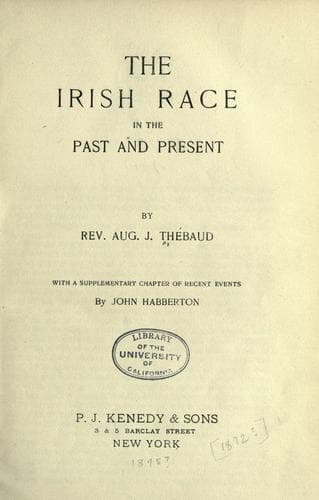
The Irish Race in the Past and the PresentThébaud, Augustus J.
History
The Irish Race in the Past and the Present
Thébaud, Augustus J.
Ireland -- History
Among those most active for the propagation of the new doctrines
were found, the Seneschal of Kilkenny, the Treasurer of Ireland,
and the Chief-Justice of the Common Pleas--all English of the
Pale. The zealous bishop, fearless of the consequences, openly
denounced them, and publicly excommunicated the Treasurer. At
once a terrible storm was raised among their English abettors,
and, in order to screen the guilty parties, they recriminated
against the prelate, and accused him of being a sharer in the
crime of Thomas Fitzgilbert, who had burned the castle of Moy
Cahir, and killed its owner, Hugh Le Poer. The temporalities of
Ledred having been already sequestrated for his boldness in
denouncing heretics, he was compelled finally to leave his
diocese and fly to Avignon, where he remained in exile for nine
years.
The Archbishop of Dublin had been one of his bitterest enemies,
and, although not actually accused of heresy himself, he was
certainly the abettor of heretics, and had done all in his power
to have Ledred arrested for his supposed crimes.
Ware, in his lives of Bicknor and Ledred, is evidently a
partisan of the first and an enemy of the second. He pretends
that Ledred tacitly acknowledged his guilt in the affair of Le
Poer, since he sued for pardon to the king, as though readers of
English history did not constantly meet with instances of
innocent men compelled to sue for pardon of crimes which they
had never committed.
We have fortunately better judges of the characters of both
prelates in the two popes, Benedict XII. and Clement VI.: the
first believing in the existence of the heresy denounced by
Ledred; the second exempting the Bishop of Ossory from the
superior jurisdiction of Bicknor, on account of the unjust
animosity displayed toward him by this worldly prelate.
The absence of all historical documents in reference to the case
leaves us at a loss to know the effect produced on Edward III.
by the letter of the Pontiff. It is highly probable that the
king preferred to believe Bicknor rather than the Pope, and
disregarded the advice of the latter.
Public-domain text, read in full here on John Shaqi.
Reviews
Reviews
No reviews yet
Be the first to share your thoughts on this work.
Elsewhere in the archive
Join the Discussion
Join the discussion
Sign in to leave a comment or review.
Sign InorCreate an account