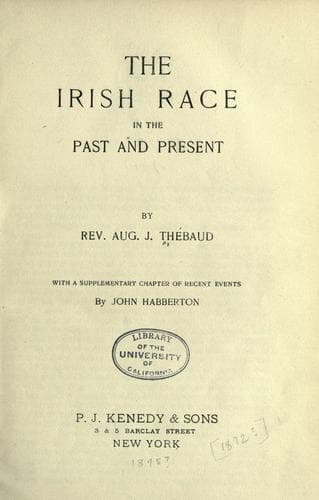
The Irish Race in the Past and the PresentThébaud, Augustus J.
History
The Irish Race in the Past and the Present
Thébaud, Augustus J.
Ireland -- History
There is, therefore, at the bottom of the Irish character, hidden
under an appearance of light-headedness, mutability of feeling--nay,
at times, futility and even childishness--a depth of according to
the eternal laws which God gave to mankind. Nothing else is in
their mind; they are pursuing no guilty and shadowy Utopia. Who
knows, then, whether their small island may not yet become the
beacon-light which, guiding other nations, shall at a future day
save Europe from the universal shipwreck which threatens her?
The providential mission of Ireland is far from being accomplished,
and men may yet see that not in vain has she been tried so long in
the crucible of affliction.
Another part of the providential plan as affecting her will show
itself, and excite our admiration, in the latter portion of the
work we undertake.
The Irish are no longer confined to the small island which gave
them birth. From the beginning of their great woes, they have
known the bitterness of exile. Their nobility were the first to
leave in a body a land wherein they could no longer exist; and,
during the seventeenth and eighteenth centuries, they made the
Irish name illustrious on all the battle-fields of Europe. At the
same time, many of their priests and monks, unable longer to labor
among their countrymen, spent their lives in the libraries, of
Italy, Belgium, and Spain, and gave to the world those immense
works so precious now to the antiquarian and historian. Every one
knows what Montalembert, in particular, found in them. They may be
said to have preserved the annals of their nation from total ruin;
and the names of the O'Clearys, of Ward and Wadding, of Colgan and
Lynch, are becoming better known and appreciated every day, as
their voluminous works are more studied and better understood.
But much more remarkable still is the immense spread of the people
itself during the present age, so fruitful in happy results for
the Church of Christ and the good of mankind. We may say that the
labors of the Irish missionaries during the seventh and eighth
centuries are to-day eclipsed by the truly missionary work of a
whole nation spread now over North America, the West India Islands,
the East Indies, and the wilds of Australia; in a word, wherever
the English language is spoken. Whatever may have been the visible
causes of that strange "exodus," there is an invisible cause clear
enough to any one who meditates on the designs of God over his
Church. There is no presumption in attributing to God himself what
could only come from Him. The catholicity of the Church was to be
spread and preserved through and in all those vast regions colonized
now by the adventurous English nation; and no better, no more
simple way of effecting this could be conceived than the one whose
workings we see in those colonies so distant from the mother-country.
Public-domain text, read in full here on John Shaqi.
Reviews
Reviews
No reviews yet
Be the first to share your thoughts on this work.
Join the Discussion
Join the discussion
Sign in to leave a comment or review.
Sign InorCreate an account