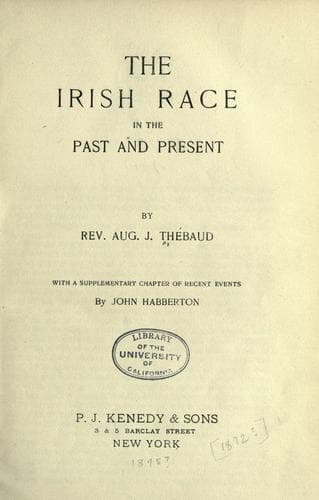
The Irish Race in the Past and the PresentThébaud, Augustus J.
History
The Irish Race in the Past and the Present
Thébaud, Augustus J.
Ireland -- History
The number of freemen, reduced to poverty, or of recent freedmen
- freed by the emancipation everywhere set on foot and
encouraged by the Church - extended the spread of communes even
to the rural districts. Thus, many villages or small towns grew
into corporations, and a social state arose, hitherto totally
unknown in Europe.
The question has been much discussed, whether those new
municipal corporations owed their origin to the municipal system
of the Romans, or were altogether disconnected with it. The
opinion commonly now accepted is, that the two systems were
utterly distinct. In some few instances, a particular Roman
municipal city may have passed into a mediaeval corporate town
under a new charter and with extended rights; but this was
certainly the exception. In the great majority of cases, the
newly-chartered cities had never before enjoyed municipal rights.
These few words suffice to show that the communes, wherever they
arose, presupposed the existence of feudalism, and the slavery
once so widely extended, passing gradually into serfdom.
But neither feudalism nor slavery, in the old pagan sense of the
word, nor even serfdom, properly so called, as the doom of the
ascripti glebae, ever existed in Ireland. There was, therefore,
no need among the Irish for the rising of communes.
Nevertheless, we do find communes existing in Ireland and
charters granted to Irish cities by English kings. But they were
merely English institutions for the special benefit of the
English of the Pale, which were always refused to "the Irish
enemy," and which the "Irish enemy," with the exception of a few
individual cases, never demanded. Consequently the fact stands
almost universally true that the rising of the communes never
extended to Ireland, and that, if the Irish never enjoyed the
benefit of them, as little did they share in the evil
consequences resulting from them.
All those evil consequences had their root in a feeling of
bitter hostility between the higher or noble classes, and not
only the villeins, whom they ground between them, but also the
middle classes, who were dwelling in the cities, emancipating
themselves by slow degrees, and forming in course of time the
"third estate."
The workings of that hostility form a great part of the history
of Europe from the twelfth century down to the present day, and
many social convulsions, recorded in the annals of the six ages
preceding our own, may be traced to it. The frightful French
Revolution was certainly a result of it, although it must be
granted that several secondary causes contributed to render the
catastrophe more destructive, the chief among which was the
spread of infidel doctrines among the higher and middle classes.
Public-domain text, read in full here on John Shaqi.
Reviews
Reviews
No reviews yet
Be the first to share your thoughts on this work.
Elsewhere in the archive
Join the Discussion
Join the discussion
Sign in to leave a comment or review.
Sign InorCreate an account