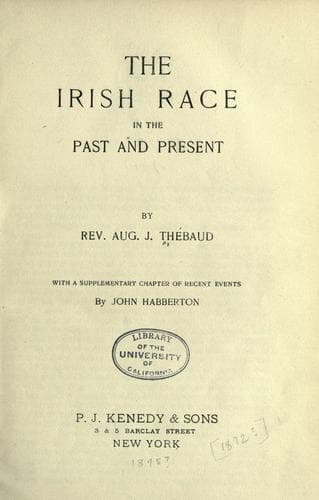
The Irish Race in the Past and the PresentThébaud, Augustus J.
History
The Irish Race in the Past and the Present
Thébaud, Augustus J.
Ireland -- History
II. The rising of the communes, one of the greatest features of
mediaeval Europe, did not extend to Ireland, separated as it
then was from the Continent. But, by reason of this very
separation, the island remained forever free from the future
political commotions of what is known as "the third estate." A
few remarks on this subject are requisite, because of the
objection brought against the Irish, that they have never known
municipal government, and also on account of the false
assertions of some philosophical historians, who allege that the
Danes and Anglo-Normans, in turn, wrought a great good to
Ireland by bringing with them the boon of citizen rights.
What were the causes of the rising of the communes in the
eleventh and following centuries? The universality of the fact
argues identity of motives, since, without common understanding
among various nations, the risings showed themselves at about
the same time in Italy, France, Germany, Spain, and England.
In ancient cities, which existed prior to the Germanic invasions,
the population, after the scourge had passed, was composed
principally of three elements: 1. Free men of the conquering
races, who were poor, and had embraced some mechanical pursuit;
2. The remnants of the Roman population, who followed some
trade; 3. Freedmen from the rural districts, who, unable to gain
a livelihood in the country, had come to reside in the cities,
where they could more easily subsist.
Thus, besides the feudal lords and the class of villeins, there
was formed everywhere a third class, that of arts and trades.
The juridical power being restricted to the lords, whose rights
extended only to the land and the men attached to it, the class
of artisans found themselves destitute of legal rights, without
a recognition or place even in the jurisprudence, as then
existing, consequently in a practically anarchical state. Hence,
they formed among themselves their own associations, elected
their own magistrates, enacted their own by-laws.
In the cities we have mentioned, the bishop alone held social
relations with the lords, whether the feudal chieftain of the
vicinity, or the Count of the city. Thus, the bishop often acted
as the mediator between the citizens and the privileged class
which surrounded them. The great object of the citizens was to
obtain a charter of rights from the suzerain, who alone could
act with justice and impartiality toward those disfranchised
burghers. To this was owed the immense number of charters
granted at that time, many of which, lately published, tend
better than any thing else to give us an insight into the origin
of municipal life in mediaeval Europe.
New cities, either founded by the invaders or springing up of
themselves around feudal castles and monasteries, soon
experienced the necessity of similar favors, which, as soon as
obtained, invested them with a social status unenjoyed before.
Public-domain text, read in full here on John Shaqi.
Reviews
Reviews
No reviews yet
Be the first to share your thoughts on this work.
Elsewhere in the archive
Join the Discussion
Join the discussion
Sign in to leave a comment or review.
Sign InorCreate an account