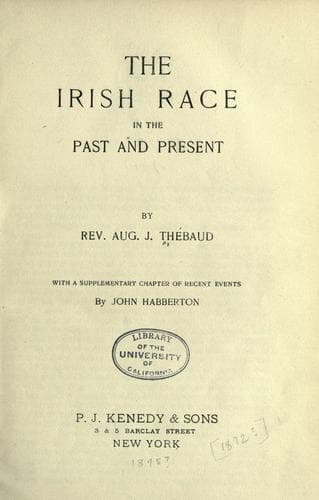
The Irish Race in the Past and the PresentThébaud, Augustus J.
History
The Irish Race in the Past and the Present
Thébaud, Augustus J.
Ireland -- History
And when the warm sunshine, created or kept alive by her, sheds
its rays on Italy, on France, on Germany, and England itself,
all her own schools are closed, her once great universities
destroyed. Clonard, Clonfert, Armagh, Bangor, Clonmacnoise, are
desolate, and the wealthy Anglo-Norman prelates find their
purses empty when the question arises of restoring or forming a
single centre of intellectual development. The natural
consequences should have been darkness, barbarism, gross
ignorance. Ireland never fell to that depth of spiritual
desolation. Her sons, though deprived of all exterior help,
would still feed for centuries on their own literary treasures.
All the way down to the Stuart dynasty, the nation preserved,
not only her clans, her princes, and her brehon laws, but also
her shanachies, her books, her ancient literature and traditions.
These the feudal barons could not rob her of; and if they would
not repay her, in some measure, for what they took away, by
flooding her with the new methods of thought, of knowledge, of
scientific investigation, at least they could not destroy her
old manuscripts, wipe out from her memory the old songs, snatch
the immortal harp from the hands of her bards, nor silence the
lips of her priests from giving vent to those bursts of
impassioned eloquence which are natural to them and must out.
Hence there was no tenth century of darkness for her--let us
bear this in mind--light never deserted her, but continued to
shine on her from within, despite the refusal of her masters to
unlock for her the floodgates of knowledge.
For this reason was it not to her an unmitigated loss; but there
is another and, perhaps, a stronger still.
We should be careful not to attribute to what is good the abuse
made of it by men; yet the good is sometimes the occasion of
evil; and so it was with those great, admirable, and much-to-be-
regretted universities.
They imparted to the mind of man an impulse which the pride and
ambition of man turned to his intellectual ruin. What was
intended for the spread of true knowledge and faith became in
the end the source of spiritual pride, the natural fosterer of
doubt and negation. Modern science, so called, that incarnation
of vanity, sophistry, error, and delusion, comes indirectly from
those universities of the middle ages; and it was chiefly at the
time of what is called the revival of learning, that the great
revolution in science came about, which changed the intellectual
gold into dross, the once divine ambrosia of knowledge, served
to happy mortals in mediaeval times, into poison.
That pretended "revival of learning" can never be mentioned in
connection with Ireland; and the "idolatry of art," and
corruption of morals, never crossed the channel which God set
between Great Britain and the Island of Saints.
Public-domain text, read in full here on John Shaqi.
Reviews
Reviews
No reviews yet
Be the first to share your thoughts on this work.
Elsewhere in the archive
Join the Discussion
Join the discussion
Sign in to leave a comment or review.
Sign InorCreate an account