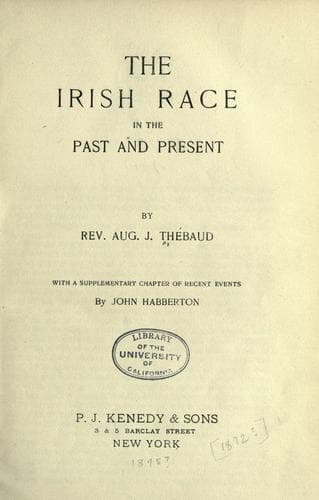
The Irish Race in the Past and the PresentThébaud, Augustus J.
History
The Irish Race in the Past and the Present
Thébaud, Augustus J.
Ireland -- History
But the great fact of the birth of a nation, in the midst of
those throes of anguish, will lessen their atrocity in the mind
of the reader, and explain to some extent the wonderful designs
of Providence.
From an English state paper, published by M. Haverty, we learn
that, in 1515, a few years before the revolt of Luther, the
island was divided into more than sixty separate states, or
"regions," "some as big as a shire, some more, some less."
Had it not been for this division and the constant feuds it
engendered, in the north between the O'Neills and O'Donnells, in
the south between the Geraldines (Desmonds and Kildares) and the
Butlers (Ormonds), the authority of the English king would have
been easily shaken off. The policy so constantly adopted by
England in after-times--a policy well expressed by the Latin
adage, Divide et impera--preserved the English power in Ireland,
and finally brought the island into outward subjection at least,
to Great Britain--a subjection which the Irish conscience and
the Irish voice and Irish arms yet did not cease to protest
against and deny. But the nation was divided, and it required
some great and general calamity to unite them together and make
of them one people.
That, even spite of those divisions, they were at the time on
the point of driving the English out of the island, we need no
better proofs than the words of the English themselves. The
Archbishop of Dublin, John Allen, the creature of Wolsey, who
was employed by the crafty cardinal to begin the work of the
spoliation of convents in the island, and oppose the great Earl
of Kildare, dispatched his relative, the secretary of the Dublin
Council, to England, to report that "the English laws, manners,
and language in Ireland were confined within the narrow compass
of twenty miles;" and that, unless the laws were duly enforced,
"the little place," as the Pale was called, "would be reduced to
the same condition as the remainder of the kingdom;" that is to
say, the Pale itself, which had been brought to such
insignificant limits, would belong exclusively to the Irish.
It was while affairs were at this pass that the revolt of
"silken Thomas" excited the wrath of Henry VIII., and brought
about the destruction of almost the whole Kildare family.
It was about this time, also, that Wolsey fell, and Cromwell,
having replaced him as Chancellor of England, with Cranmer as
Archbishop of Canterbury, the Reformation began in England with
the divorce of the king, who shortly after assumed supremacy in
spirituals as a prerogative of the crown, and made Parliament --
in those days himself--supreme law-giver in Church and state.
Public-domain text, read in full here on John Shaqi.
Reviews
Reviews
No reviews yet
Be the first to share your thoughts on this work.
Elsewhere in the archive
Join the Discussion
Join the discussion
Sign in to leave a comment or review.
Sign InorCreate an account