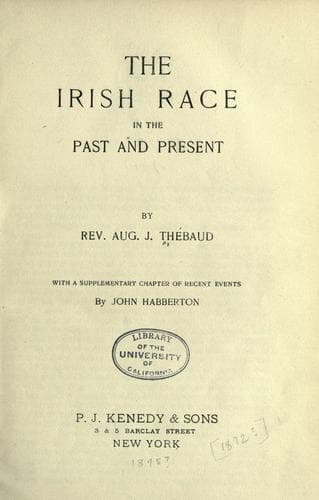
The Irish Race in the Past and the PresentThébaud, Augustus J.
History
The Irish Race in the Past and the Present
Thébaud, Augustus J.
Ireland -- History
By losing the only bond of unity--the power vested in the Ard-
Righ--which held the various parts of the island together,
Ireland lost all power of exercising any combined action. The
nations were as numerous as the clans, and the interests as
diverse as the families. They possessed, it is true, the same
religion, and in the observance of its precepts and practices
they often found a remedy for their social evils; but religion,
not encountering any opposition from any quarter, with the
exception of the minor differences existing between the native
clergy and the English dignitaries, was generally considered as
out of the question in their wranglings and contentions. We
shall see how the blows struck at it by the English monarchs
welded into one that people, were the cause of that union now so
remarkable among them, and really constituted the only bond that
ever linked them together.
Before dwelling on these considerations, let us glance a moment
at the state of the country prior to the attempt of introducing
Protestantism there.
The English Pale was reduced at this period to one half of five
counties in Leinster and Meath; and even within those boundaries
the 0'Kavanaghs, O'Byrnes, O'Moores and others, retained their
customs, their brehon laws, their language and traditions, often
making raids into the very neighborhood of the capital, and
parading their gallowglasses and kerns within twenty miles of
Dublin.
The nobility and the people were in precisely the same state
which they had known for centuries. The few Englishmen who had
long ago settled in the country had become identified with the
natives, had adopted their manners, language, and laws, so
offensive at first to the supercilious Anglo-Normans.
But a revolution was impending, owing chiefly to the change
lately introduced into the religion of England, by Henry Tudor.
It is important to study the first attempt of the kind in
Ireland; not only because it became the occasion of establishing
for a lengthy period a real unanimity among the people--giving
birth to the nation as it were--but also for the right
understanding of the word "rebellion," which had been so freely
used before toward the natives, and which was now about to
receive a new interpretation.
The English had once deceived the Irish, exacting their
submission
in the twelfth century by foisting upon them the word homage:
they would deceive Europe by a constant use, or rather misuse,
of the words "rebel" and "rebellion." By the enactment of new
laws they pronounce the simple attachment to the old religion of
the country a denial of sovereign right, and consequently an act
of overt treason; and the Irish shall be butchered mercilessly
for the sake of the religion of Christ without winning the name,
though they do the crown, of martyrdom; for Europe is to be so
effectually deceived, that even the Church will hesitate to
proclaim those religious heroes, saints of God.
Public-domain text, read in full here on John Shaqi.
Reviews
Reviews
No reviews yet
Be the first to share your thoughts on this work.
Elsewhere in the archive
Join the Discussion
Join the discussion
Sign in to leave a comment or review.
Sign InorCreate an account