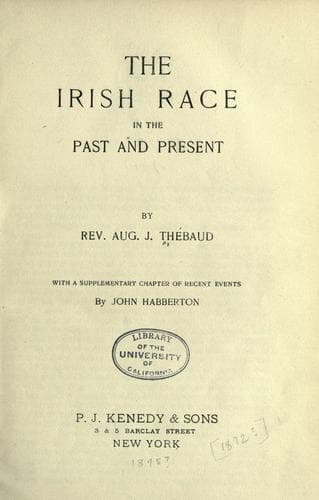
The Irish Race in the Past and the PresentThébaud, Augustus J.
History
The Irish Race in the Past and the Present
Thébaud, Augustus J.
Ireland -- History
This project, complete as it was, was far from being the only
one proposed at that time for "rooting out the Irish" from
Ireland. Mr. Prendergast, in his "Introduction to the
Cromwellian Settlement," says:
"The Irish were never deceived as to the purport of the English,
and, though the Pale had not been extended for two hundred and
forty years, their firm persuasion in the reign of Henry VIII.
was, that the original design was not abandoned. 'Irishmen are
of opinion among themselves,' said Justice Cusack to the king,
'that Englishmen will one day banish them from their lands
forever.'"
In fact, project after project was then proposed for clearing
Ireland of Irish to the Shannon. Some went so far as already to
contemplate their utter extirpation; but "there was no precedent
for it found in the chronicles of the conquest. Add to this the
difficulty of finding people to reinhabit it if suddenly
unpeopled.
"The chiefs and gentlemen of the Irish only were to be driven
from their properties," according to some of those projects,
"and they only were to be driven into exile, while their lands
should be given to Englishmen."
"The king, however, seems to have been satisfied with
confiscating the estates of the Earl of Kildare and of his
family. Fierce and bloody though he was, there was something
lion-like in his nature; notwithstanding all those promptings,
he left to the Irish and old English their possessions, and
seemed even anxious to secure them, but failed to do so for want
of time."
We think Mr. Prendergast's judgment of Henry VIII. too favorable.
Generosity did not prompt him to spare the people and the
nobles, with the exception of the Kildares. We believe that he
never contemplated the extirpation of the people, because such a
political element could not enter into his mind. As for the
nobles, he wished to gain them over, because of the long wars he
foresaw necessary to bring about their utter extinction or exile.
He adopted, accordingly, a plan of his own, holding firm to his
design of having his new title of "Head of the Church"
acknowledged in Ireland as well as in England.
Cromwell commenced his work by two measures which had met with
perfect success in the latter country, but which were destined
to fire the sister isle from end to end, and make "the people,"
in course of time, really one. These measures were acts of
Parliament: 1. Establishing 'the king's spiritual supremacy; 2.
Suppressing, at once, all the monasteries existing in the
country, and giving their property to the nobles who were
willing to apostatize.
Public-domain text, read in full here on John Shaqi.
Reviews
Reviews
No reviews yet
Be the first to share your thoughts on this work.
Elsewhere in the archive
Join the Discussion
Join the discussion
Sign in to leave a comment or review.
Sign InorCreate an account