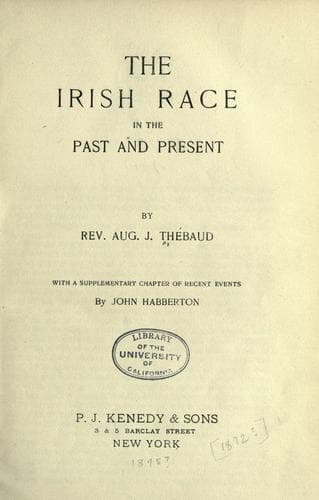
The Irish Race in the Past and the PresentThébaud, Augustus J.
History
The Irish Race in the Past and the Present
Thébaud, Augustus J.
Ireland -- History
The necessity of convening Parliament resulted from the failure
of the first attempt, already made, to establish the king's
supremacy. Browne, the successor of Allen in the See of Dublin,
a rank Lutheran at heart, had been commissioned by the king and
by Cranmer, his consecrator, to establish the new doctrine at
once. His want of success, is thoroughly explained in a letter
to Cromwell, which is still preserved, and which remains one of
the proudest monuments of the steadfastness of the Irish in
their religion.
He complains that not only the clergy, but the "common people,"
were "more zealous in their blindness than the saints and
martyrs in truth, in the beginning of the Gospel," and "such was
their hostility against him that his life was in danger."
And all this in Dublin, in the heart of the Pale, where the
chief antagonist of the new doctrine, "the leader of the people"
against this first attempt at schism, was Cromer, the Archbishop
of Armagh, an Englishman himself! So that those prelates of
England, who, with the exception of the noble Fisher, had all
yielded without a murmur of opposition to the will of Henry,
could find no followers, not even of their own nation, in
Ireland, so much had their faith been strengthened by contact
with that of "the common people."
A Parliament was needed, therefore, and that one which was to be
the instrument of introducing the great English measure, met for
the first time in Dublin, on the 1st of May, 1536; but, being
prorogued, it met again in 1537, and did not complete its work
until once more summoned in 1541, when the old Irish element was
for the first and last time introduced at its sitting, in order,
if possible, to consecrate the new doctrine by having it
solemnly accepted by the old race.
This Parliament, which was first convened in Dublin, McGeoghegan
says, "adjourned to Kilkenny, thence to Cashel, after ward to
Limerick, and lastly to Dublin again." The chief cause of these
interruptions was the difficulty of bringing an Irish Parliament,
even when composed of Englishmen, as was the case up to 1541,
to pass the decrees of supremacy, denial of Roman authority, etc.,
which had been so readily accepted in England.
The Irish Parliaments, as far back as we can see, were composed
not only of lords, spiritual and temporal, and of deputies of
the Commons, but each diocese possessed also the right to send
there three ecclesiastical proctors, who, by reason of their
office, owned neither benefice nor fief, and were therefore at
liberty to vote, fearless of attainder and confiscation, in
accordance with their conscience and their sense of right.
Public-domain text, read in full here on John Shaqi.
Reviews
Reviews
No reviews yet
Be the first to share your thoughts on this work.
Elsewhere in the archive
Join the Discussion
Join the discussion
Sign in to leave a comment or review.
Sign InorCreate an account