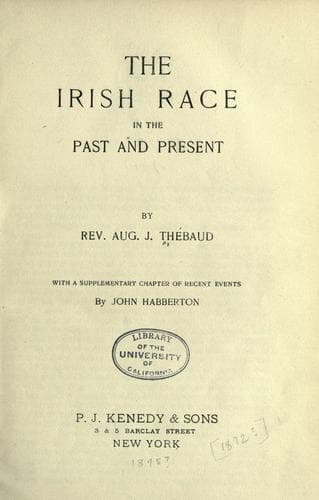
The Irish Race in the Past and the PresentThébaud, Augustus J.
History
The Irish Race in the Past and the Present
Thébaud, Augustus J.
Ireland -- History
In all those countries, it was called populus Christianus; it
had its associations, its guilds, its Christian customs, its
privileges, its rights. Its existence was acknowledged by law,
and it possessed everywhere either Christian codes, or at least
local customs for its safeguards. It gradually grew into a great
power, and took the name of the "Third Estate," ranking directly
after the clergy, and nobility. Its members knew and respected
the gradations of the social hierarchy as then existing. The
monarchs in most countries, in France chiefly, sided with it
whenever the nobles sought to oppress it, and its deputies were
heard in the Parliaments of the various nations of Christendom.
How many millions of human beings lived happily during several
centuries under these great institutions of mediaeval times! And
if the members of the people at that time could seldom rise
above their order, except through the Church, this unfortunate
inability often prevented dangerous and subversive ambitions,
and was thus really the source and cause of, happiness to all.
Governments at that period lasted for thousands of years; men
could rely on the stability of things, and great enterprises
could be undertaken and carried to a successful termination.
But throughout all Europe, with the single exception of Ireland,
the people had to contend against the feudal power; and it was
only very gradually, and step by step, that it could creep up to
its rights. In Ireland, as we have seen, feudalism had failed to
strike root; so that the clansmen who represented there what the
people did elsewhere, never having been subject to slavery or
serfdom, possessed all the liberties which the ordinary class of
men can claim. They had always borne their share in the affairs
of their own territory, at least by the willing help they
afforded to their leaders, during the Danish wars chiefly, and
afterward throughout the four hundred years of struggle with the
Anglo-Normans. The people were the real conquerors under the
lead of their chieftains, and the perpetual enjoyment of their
beloved customs was the privilege of the least among them as
much as of the proudest of their nobles. They themselves were
well aware of this, and to their own efforts no less than to the
heads of the clans they attributed the advantages which they had
gained.
Thus, when the conduct of their chieftain was not in accordance
with what the clansmen considered the right, they were ready to
express their disapproval of his actions by deposing him, and
placing their allegiance at the service of the man of their
choice.
Public-domain text, read in full here on John Shaqi.
Reviews
Reviews
No reviews yet
Be the first to share your thoughts on this work.
Elsewhere in the archive
Join the Discussion
Join the discussion
Sign in to leave a comment or review.
Sign InorCreate an account