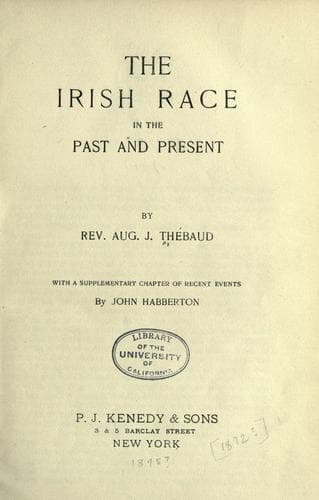
The Irish Race in the Past and the PresentThébaud, Augustus J.
History
The Irish Race in the Past and the Present
Thébaud, Augustus J.
Ireland -- History
Whenever in those ancient governments we find the lower classes
unable longer to bear the heavy yoke imposed upon them,
revolting against a despotism which had grown insupportable, and
claiming their natural rights, it was merely a surging of waves
raised to mountain-height by the fury of a sudden storm, but
soon allayed and subdued beneath the inflexible will of stern
rulers. The people was a mere mob, whose violence, when
successful, fatally carried destruction with it; and, though it
is seemingly full of a terrible power which nothing can resist,
its power lasts but for a very short time. Could it only outlast
the destruction of all superior rulers, it would end by
destroying itself.
If we would meet with the people, such as we conceive it to be
in accordance with our Christian ideas, we must come down to
that period of time which followed close upon the organization
of Christendom, namely, to the much-abused middle ages.
Feudalism, it is true, withstood its expansion for a long time,
kept alive the remnants of slavery which it had found in Europe
at its birth, or at best invented serfdom as a somewhat milder
substitute for the former degradation of man. But feudalism
itself was not strong enough to prevent the natural consequences
of the vigorous Christianity which at that time prevailed; and
kings, dukes, and feudal bishops, were compelled to grant
charters which insured the freedom of the subject. Then the
people appeared, in the cities first, afterward in the country,
where, however, the peasants had still to drag on for a weary
time the chains of secular serfdom.
Thus the people lived in Spain, where they fought valiantly
under their lords for centuries against the Crescent, so that in
some provinces all classes were ennobled, and not a single
plebeian was to be found, which simply means that the whole mass
of the citizens formed the people. Thus the people had an early
existence in Italy, where every city almost became a centre of
freedom and activity, notwithstanding strife and continual feuds.
Thus the people had its life in France, where the learned men
of Catholic universities determined with precision the limits of
kingly power, and where the outburst of the Crusades brought all
classes together to fight for Christ, forming but one body
engaged alike throughout in a holy cause. Thus, finally, the
people had its life even in Germany and England, where real
liberty, though of later birth, afterward remained more deeply
rooted in social life.
Public-domain text, read in full here on John Shaqi.
Reviews
Reviews
No reviews yet
Be the first to share your thoughts on this work.
Elsewhere in the archive
Join the Discussion
Join the discussion
Sign in to leave a comment or review.
Sign InorCreate an account