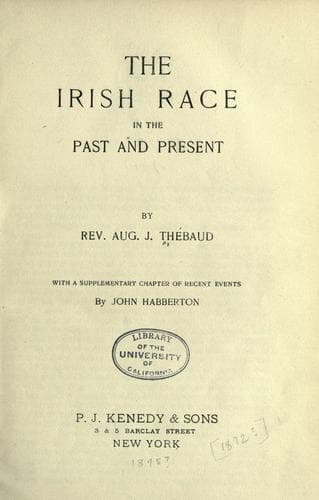
The Irish Race in the Past and the PresentThébaud, Augustus J.
History
The Irish Race in the Past and the Present
Thébaud, Augustus J.
Ireland -- History
But if of all men it makes one family with respect to spiritual
matters, what unanimity of feeling must it not create in a
single nation truly imbued with its spirit, which is attacked
for its sake? Until the reign of Henry VIII., the Irish, in
their struggle with England, could summon no religious thought
to their aid, since England was Catholic also, and the Norman
nobles established among them followed the same calendar,
possessed the same churches, the same creed, the same sacraments.
But as soon as the English power was stamped with heresy, the
opposition to that power assumed a religious aspect, and no
longer restricted itself to the clans immediately attacked, but
spread throughout the whole nation.
To bring the case down to some particular point, in order to
render our meaning more clear, a priest or monk, who was hunted
down, was no longer sure of refuge in his own district, and
among men of his own sept merely, but he was equally welcomed in
the castle of the chieftain or the hut of the peasant through
the length and breadth of the land. Any Irishman, subject to
fine, imprisonment, or torture, for the sake of his religion,
did not find sympathy restricted to his own circle of friends or
acquaintances, but, even if tried and prosecuted in a corner of
the island, far away from his own home, he could count upon the
sympathy of as many friends as there were Irish Catholics to
witness his sufferings. This state of things was certainly
unknown before.
Religion, when deep, is the strongest feeling of the human heart,
and endows the nation steeped in it with an unconquerable
strength. To judge of the intensity of religious feeling in the
Irish, it should be remembered that it was the only legacy left
them after every thing else had been taken away, and, though it
was the special object of attack, they were to be stripped one
by one of their old customs, their own chieftains, their houses
of study and of prayer, their religious and secular teachers,
nay, of the chance even of educating their children, of the
right to possess not merely their own soil, but even to
cultivate a few acres of it, nay, of their very language itself,
in a word, of all that makes a country dear to man. For ages
were they destined to remain outcasts and strangers on the soil
which was their own; abject and ignorant paupers, without the
faintest possibility of rising in the social scale.
One thing only did they keep in their hearts, their faith,
though stripped of all the exterior circumstances which adorn it,
and reduced to its simplest elements. But at least it was their
religion, to deprive them of which, all the wealth, resources,
armies, laws of a powerful nation, were to be strained to the
utmost during long ages. How, then, could they fail to love and
cherish it, to cling fast to it, as to an inestimable treasure,
the only real one indeed they could possess on earth, where all
else passes away?
Public-domain text, read in full here on John Shaqi.
Reviews
Reviews
No reviews yet
Be the first to share your thoughts on this work.
Elsewhere in the archive
Join the Discussion
Join the discussion
Sign in to leave a comment or review.
Sign InorCreate an account