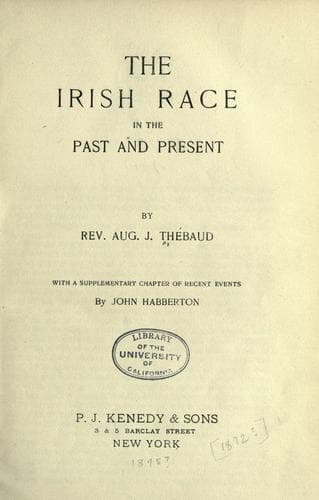
The Irish Race in the Past and the PresentThébaud, Augustus J.
History
The Irish Race in the Past and the Present
Thébaud, Augustus J.
Ireland -- History
Here, then, always presupposing the paramount influence of the
grace of God, lay the secret of that indestructible strength and
unwearied energy manifested by Irishmen, from the middle of the
sixteenth century down, and we are enabled thus to appreciate
the value of that unity which persecution alone fastened upon
them.
To the love of religion, which was the origin of that unity,
love of country was soon added, and by love of country we here
understand the love of the whole island, not merely of the
particular sept to which the individual belonged, or of the
particular spot in which he happened to be born. Such had been
the divisions among the people and the chieftains hitherto, that
England could attack one sept without fearing the revolt of the
others, nay, was often assisted by an adverse clan. And so
thoroughly had the Anglo-Normans adopted the native manners,
that the Kildares were frequently at war with the Desmonds,
though both belonged to the same Geraldine family; and the
Ormonds kept up a constant feud with both the Geraldine branches.
When Henry VIII. almost destroyed the Kildares, we do not find
that the Desmonds felt their loss at first; perhaps they even
rejoiced at it.
It was the same with the natives, particularly with the 0'Neills
and the O'Donnells, in the north. The whole island and its
general interests seemed the concern of no one, so taken up were
they by the affairs of their own particular locality. And this
state of feeling had existed from the beginning, even among holy
men. The songs of Columba, of Cormac McCullinan, even of the
Fenian heroes of old, all celebrated the victories of one sept
over another, or the beauties of some one spot in the island, in
preference to all others.
Nay, so prevalent was this clannish spirit, even at the
beginning of the religious troubles, that Henry VIII., and
Elizabeth after him, gained their successes by directing their
attacks against particular places, so certain were they that the
other districts would not come to the rescue.
The feeling of nationality, of what we call patriotism, wrestled
along time in the throes of birth, before coming forth, and it
was only during the latter half of Elizabeth's reign that those
confederacies were formed, which included the whole country and
called in even foreign aid.
But this feeling began to appear as soon as religion was
attacked; and therefore do we call this epoch the true birth of
a people.
And as it is with the people chiefly that we are concerned, it
is to our purpose to remark here that they gradually lost sight
of their petty quarrels and local prejudices in losing their
chieftains; they began to look for leaders among themselves, and,
understanding at last that the whole island was threatened by
the invading policy of England, they were to fight for the whole,
and not for any special district.
Public-domain text, read in full here on John Shaqi.
Reviews
Reviews
No reviews yet
Be the first to share your thoughts on this work.
Elsewhere in the archive
Join the Discussion
Join the discussion
Sign in to leave a comment or review.
Sign InorCreate an account