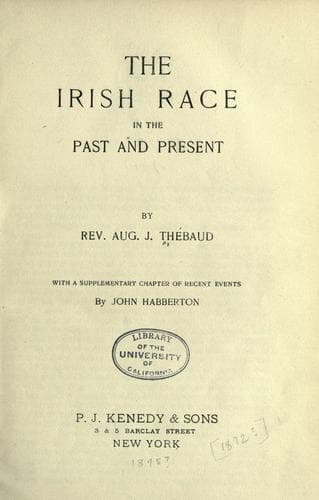
The Irish Race in the Past and the PresentThébaud, Augustus J.
History
The Irish Race in the Past and the Present
Thébaud, Augustus J.
Ireland -- History
But this general reflection is not enough for our purpose, which
is, to delineate and bring out the true character of the nation.
It is, therefore, fitting to give an idea of the extent to which
the monastic influence prevailed, and of the nature of the
people who cherished, loved, and accepted it at all times.
It may be said that the Christian Church, as established in the
island by St. Patrick, rested mainly for its support on the
religious orders. In many cases the abbots of monasteries were
superior to bishops, and, as a general rule, the hierarchy of
the Church was, as it were, subordinate to monastic
establishments.1 (1 Vide Montalembert's "Monks of the West:
Bollandists, Oct.," tome xii., p. 888.) At the time we speak of,
indeed, such was no longer the case; but the previously-existing
state of reciprocal subordination between abbots and bishops
during several centuries, in Ireland,, had left deep traces in
the nature of the institutions and of the people itself. It may
be said that in the mind of an Irishman the existence of
Christianity almost presupposed a numerous array of convents and
religious houses. And this idea of theirs can scarcely be called
a wrong one, nor did they exaggerate the value of religious
orders, since their estimate of them was no higher than that of
Christ himself and his Church.
If with justice it was said that the French monarchy was
established by bishops, with equal justice may it be said that
the Irish people had been educated, nay, created by monks. The
monks had taken the place left vacant by the Druids, and thus
they became for the Christian what the others had been for the
pagan Irish. For a long period the Irish monks formed a very
considerable portion of the population. In their body were
concentrated the gifts of science, art, holiness, even miracles
without number, unless we are to suppose that the hagiography of
the island was intrusted to the care of idiots incapable of
ascertaining current facts. The vast literature of the island,
greater indeed than that of any other Christian country at the
time, was either the product of monastic intellect and learning,
or at least had been translated and preserved by monks. The
gifted Eugene O'Curry could fill numbers of the pages of his
great work with the bare titles of the books which are known to
have issued from the Irish monasteries, of which but a few
fragments remain; and no sensible man who has read his book can
affect to despise establishments which could produce so many
proofs of fancy, intellect, and erudition. The scattered
fragments of that rich literature, which had escaped the fury of
the Scandinavian, the ignorance and rapacity of the early Anglo-
Norman, the blind fanaticism of the Puritan, could still in the
seventeenth century furnish materials enough for the immense
compilations of the Four Masters, Ward, Wadding, Lynch, and
Colgan.
Public-domain text, read in full here on John Shaqi.
Reviews
Reviews
No reviews yet
Be the first to share your thoughts on this work.
Elsewhere in the archive
Join the Discussion
Join the discussion
Sign in to leave a comment or review.
Sign InorCreate an account