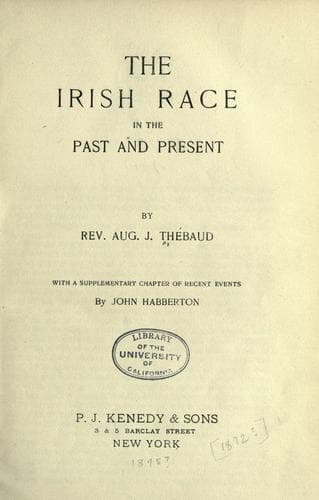
The Irish Race in the Past and the PresentThébaud, Augustus J.
History
The Irish Race in the Past and the Present
Thébaud, Augustus J.
Ireland -- History
And, under 1540, they say: "The English, in every place
throughout Ireland, where they established their power,
persecuted and banished the nine religious orders, and
particularly they destroyed the monastery of Monaghan, and
beheaded the guardian and a number of friars."
We may add that, at the restoration of the old faith under Queen
Mary, nothing had to be restored in Ireland save the monasteries.
These establishments had, almost without exception, been
ruthlessly destroyed.
In our previous considerations, we have spoken of no other
religious houses in Ireland, save those of the old Columbian
order of monks, as it was called, which was a growth of the
country, and bore so many marks of Irish peculiarities. This
continued until, communications with Rome becoming more frequent,
the various orders established in the West were successively
introduced into Ireland. Our purpose is not to write a history
of monasticism, and therefore we do not intend entering into
details on this point, interesting though they are. But we may
add that, gradually, the old monasteries - from the Norman
invasion chiefly - as well as the new ones which were
established, were placed under the rule of the various
congregations, acknowledged by the Holy See. It seems that the
monasteries founded by St. Columba himself afterward submitted
to the rule of St. Benedict, the others, for the most part,
embracing that of the canons regular of St. Augustine; but the
precise epoch of these changes is not known. It is certain,
however, that the Benedictines, Cistercians, and Bernardines,
were introduced into the country at a very early date, together
with the four mendicant orders of Franciscans, Dominicans,
Carmelites, and Augustinians.
The pretext for their destruction was, of course, the same in
England as in all the other countries of Europe - their need of
reformation; but it does not appear that even this pretence was
put forward in the case of the Irish monasteries. The fact was,
the breath of suspicion could not rest upon those stainless
establishments in the Isle of Saints. In the idea of the natives,
their very names had ever been synonymous with holiness and all
Christian virtues, and so they continued to enjoy the most
unbounded popularity. The fact of the English Government
selecting them as a special point of attack is in itself
sufficient to vindicate their character from any aspersion. Two
measures were deemed necessary and sufficient for the purpose of
detaching Ireland from its allegiance to the Holy See, and of
introducing schism, if not heresy, into the country. One, and
certainly the most efficacious of these, was thought to be the
destruction of convents for both sexes. This, we affirm, is
ample apology for their inmates.
Public-domain text, read in full here on John Shaqi.
Reviews
Reviews
No reviews yet
Be the first to share your thoughts on this work.
Elsewhere in the archive
Join the Discussion
Join the discussion
Sign in to leave a comment or review.
Sign InorCreate an account