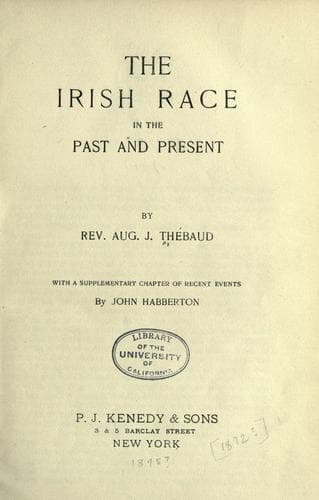
The Irish Race in the Past and the PresentThébaud, Augustus J.
History
The Irish Race in the Past and the Present
Thébaud, Augustus J.
Ireland -- History
But in other countries besides the one under our consideration
religious houses and institutions have sometimes been
effectually rooted out, at least for a time. When the French
Constituent Assembly, by one of its destructive decrees, closed
those establishments all over France, such of them as by their
laxity deserved to die, ceased at once to exist, and poured
forth their inmates to swell the ranks of a corrupt society, and
add religious degradation to the immoral filth of the world.
Those religious houses, within whose walls the spirit of God had
not ceased to dwell, were indeed closed and emptied; but their
inmates endeavored to live their lives of religion in some
unknown and obscure spot, until the madness of the Convention,
and the Reign of Terror which soon followed, rendered the
continuation of the holy exercises of any community absolutely
impossible. But mark this well: the holy aims of the monks and
nuns found no response in the nation, and, finding themselves
almost entirely rejected by a faithless people, with no resting-
place in the whole extent of the country, a sudden and total
interruption of religious ascetic life in the once most Catholic
nation of Europe was the result.
The same may soon come to pass in our days in Italy and Spain,
until better times return to those now distracted countries, and
the extremities of evil bring them back to something of their
primitive faith.
Not so in Ireland: the communities could continue to exist even
when turned out-of-doors, because the nation wanted them, and
could afford them asylum and peace in the worst periods of
persecution. And this great fact of the mutual love between
monks, priests, and people, contributed also in no small degree
to that union among all, which henceforth became the
characteristic feature of a people hitherto split up into
hostile clans. Nothing probably tended so much toward effecting
the birth of the nation as the deep attachment existing between
the Irish and their religious orders. The latter had always
preached peace and often reconciled enemies, and brought furious
men to the practice of Christian charity and forbearance.
We have seen instances of this when the clans were all powerful
and the chieftains thought of nothing but of "preyings," as they
called them, compelling their enemies to give "hostages" and
devastating the territories of hostile clans. Then the voice of
the monk came to be heard in the midst of contending passions,
and real miracles were often performed by them in changing into
lambs men who resembled roaring lions or devouring wolves; but
their action became much more efficacious when nothing was left
to the people save their religion and the "friars." These, it is
true, could no longer reside within the walls of their convents,
but on that very account their life became more truly one with
that of the people.
Public-domain text, read in full here on John Shaqi.
Reviews
Reviews
No reviews yet
Be the first to share your thoughts on this work.
Elsewhere in the archive
Join the Discussion
Join the discussion
Sign in to leave a comment or review.
Sign InorCreate an account