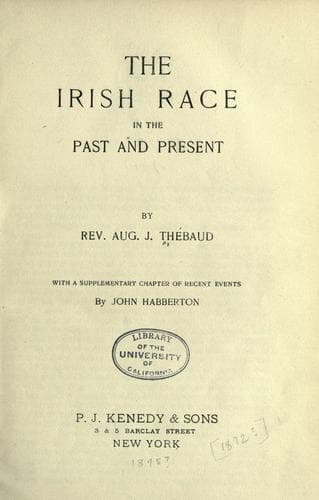
The Irish Race in the Past and the PresentThébaud, Augustus J.
History
The Irish Race in the Past and the Present
Thébaud, Augustus J.
Ireland -- History
Sometimes they found refuge in the large, hospitable dwellings
of the native nobility, where, during the latter part of the
reign of Henry VIII. and the whole of that of Elizabeth, the
almost independent power of the chieftains could still afford
them succor. Sometimes also the humbler dwelling of the farmer
or the peasant offered them a sure asylum, wherein they could
practise their ministry in almost perfect freedom, owing to the
sure and inviolable secrecy of the inmates and neighbors. For a
great distance around, the Catholics knew of their abode, were
often visited by them, even without mach danger of the fact
becoming known to spies and informers. And this brings naturally
before us a new feature of the Irish character.
Their nature, which was so expansive and passionate on all other
subjects, so that to keep a secret was an impossible feat to
them, wore another character when danger to their religion or
its ministers required of them to set a seal on their lips. For
years frequently, large numbers of priests and religious could
not only exist, but move and work among them, without their
place of abode becoming known to the swarms of enemies who
surrounded them. The nation was trained to prudence and
discretion by centuries of oppression and tyranny. Many facts of
this nature are known and recorded in the dark annals of those
times; but how many more will be known never!
Thus, in the year 1588, during the worst part of Elizabeth's
reign, "John O'Malloy, Cornelius Dogherty, and Walfried Ferral,
of the order of St. Francis, fell finally victims to the malice
of the heretics. They had spent eight years in administering the
consolations of religion throughout the mountainous districts of
Leinster. Many families of Carlow, Wicklow, and Wexford, had
been compelled to take a refuge in the mountains from the fury
of the English troops. The good Franciscans shared in all their
perils, travelling about from place to place, by night; they
visited the sick, consoled the dying, and offered up the sacred
mysteries for all. Oftentimes the hard rock was their only bed;
but they willingly embraced nakedness, and hunger, and cold, to
console their afflicted brethren." - (Moran's Archbishops of
Dublin.)
In these few words, we have a picture of the mountain monastery.
During those eight years, how many Irish were consoled and
comforted by those few laborers, who, driven from their holy
home, had chosen to live in the wilderness, and practise their
rule among the wandering people of three large counties,
receiving in return the substance, the love, and loving secrecy
of their flock! We have only to figure to ourselves this scene,
or similar, repeated in every corner of the land, and we may
then easily understand how the Irish people were brought to the
unanimous resolve of standing by each other, and how, from the
state of complete division which formerly prevailed, the
elements of a compact, solid, and indestructible body, began to
form.
Public-domain text, read in full here on John Shaqi.
Reviews
Reviews
No reviews yet
Be the first to share your thoughts on this work.
Elsewhere in the archive
Join the Discussion
Join the discussion
Sign in to leave a comment or review.
Sign InorCreate an account