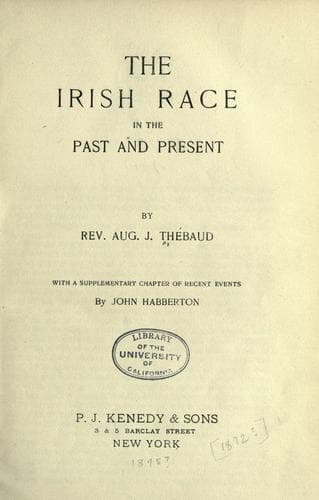
The Irish Race in the Past and the PresentThébaud, Augustus J.
History
The Irish Race in the Past and the Present
Thébaud, Augustus J.
Ireland -- History
Whatever the means adopted to introduce and carry out the new
policy, it was certainly enacted that "the queen was the head of
the Church of Ireland, the reformed worship was reestablished as
under Edward VI., and the book of common prayers, with further
alterations, was reintroduced. A fine of twelve pence was
imposed on every person who should not attend the new service,
for each offence; bishops were to be appointed only by the queen,
and consecrated at her bidding. All officers and ministers,
ecclesiastical or lay, were bound to take the oath of supremacy,
under pain of forfeiture or incapacity; and any one who
maintained the spiritual supremacy of the Pope was to forfeit,
for his first offence, all his estates, real and personal, or be
imprisoned for one year, if not worth twenty pounds; for the
second offence, to be liable to praemunire; and for the third,
to be guilty of high-treason."
It was understood that those laws would be strictly enforced
against all priests and friars, though left generally
inoperative for lay people; and, with certain exceptions,
mentioned by Dr. Curry, such was the rule observed. Thus, the
reign of Elizabeth, which was such a cruel one for ecclesiastics,
produced few martyrs among the laity in Ireland. And, for this
reason, Sir James Ware is able to boast that, in all the
"rebellions" of the Irish against Elizabeth; they falsely
complained that their freedom of worship was curtailed, as
though they could worship without either priests or churches.
But the law was passed which made it "high-treason" to assert,
three times in succession, the spiritual supremacy of the Pope;
and, henceforth, whoever should suffer in defence of that
Catholic dogma, was to be a traitor and not a martyr.
The woman, seated on the English throne, speedily discovered
that it was not so easy a matter to change the religion of the
Irish as it had been to subvert completely that of her own
people.
Deprived of religious houses and means of instruction, deprived
of priests and churches, no communication with Rome save by
stealth, the Irish still showed their oppressors that their
consciences were free, and that no acts of Parliament or
sentences of iniquitous tribunals could prevent their remaining
Catholics.
By promising to deal as lightly with the laity as severely with
the clergy, Elizabeth felt confident that the Catholic religion
would soon perish in Ireland, and that, with the disappearance
of the priests, the churches, sacraments, instruction, and open
communion with Rome, would also disappear. To all seeming, her
surmises were correct; but the people were silently gathering
and uniting together as they had never done before.
Public-domain text, read in full here on John Shaqi.
Reviews
Reviews
No reviews yet
Be the first to share your thoughts on this work.
Elsewhere in the archive
Join the Discussion
Join the discussion
Sign in to leave a comment or review.
Sign InorCreate an account