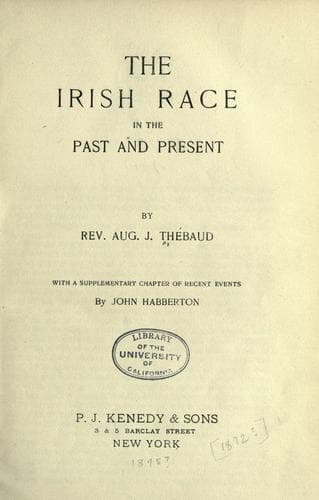
The Irish Race in the Past and the PresentThébaud, Augustus J.
History
The Irish Race in the Past and the Present
Thébaud, Augustus J.
Ireland -- History
The members of the Irish Parliament, although of English descent,
could not so easily reconcile themselves to these rapid changes
as their fellows in England had done; in fact, they laid claim
to a conscience--a thing seemingly unknown to the English
members, or, if known at all, of an exceedingly elastic and
slippery nature. Here lay the difficulty: how was it to be
overcome? The conversation between Elizabeth and Sussex must
have been of a very interesting character.
Returning with private instructions from the queen, the Earl of
Sussex again convened the Parliament, which only consisted of
the so called representatives of ten counties--Dublin, Meath,
West Meath, Louth, Kildare, Carlow, Kilkenny, Waterford,
Tipperary, and Wexford. We see that the almost total extinction
of the Kildare branch of the Geraldines had extended the English
Pale. The other deputies were citizens and burgesses of those
towns in which the royal authority predominated. "With such an
assembly," says Leland, "it is little wonder that, in despite of
clamor and opposition, in a session of a few weeks, the whole
ecclesiastical system of Queen Mary was entirely reversed." It
is needless to remark that the people had nothing whatever to do
with this reversal; it merely looked on, or was already
organizing for resistance.
Nevertheless, even in that assembly the queen's agents were
obliged to have recourse to fraud and deception, in order to
carry her measures, and it cannot be said that they obtained a
majority.
"The proceedings," according to Mr. Haverty, "are involved in
mystery, and the principal measures are believed to have been
carried by means fraudulent and clandestine." And, in a note, he
adds: "It is said that the Earl of Sussex, to calm the protests
which were made in Parliament, when it was found that the law
had been passed by a few members assembled privately, pledged
himself solemnly that this statute would not be enforced
generally on laymen during the reign of Elizabeth."1 (1 Dr.
Curry, in his "Civil Wars," has collected some curious facts in
illustration of this point.)
Public-domain text, read in full here on John Shaqi.
Reviews
Reviews
No reviews yet
Be the first to share your thoughts on this work.
Elsewhere in the archive
Join the Discussion
Join the discussion
Sign in to leave a comment or review.
Sign InorCreate an account