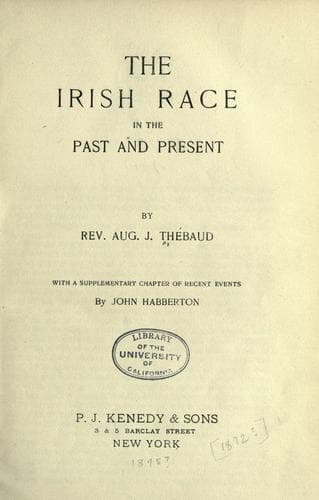
The Irish Race in the Past and the PresentThébaud, Augustus J.
History
The Irish Race in the Past and the Present
Thébaud, Augustus J.
Ireland -- History
The title of conquest, at that time a valid one in all countries,
had no value with the Irish who never had been and never
admitted themselves to have been conquered. Had they not
preserved their own laws, customs, language, local governments?
Had the English ever even attempted to subject them to their
laws? They had openly refused to grant their pretended benefits
to those few "degenerate Irishmen" who in sheer despair had
applied for them. This policy of separation was adopted by
England with the view of "rooting out" the Irish. The English
Government could therefore only accept the natural consequence
of such a system--that the Irish race should be left to itself,
in the full enjoyment of its own laws and local governments.
The very policy of Henry VIII. and Elizabeth, as displayed in
their attempt to break down the clans by favoring "well-disposed
Irishmen" and setting them up, by fraudulent elections, as
chiefs of the various septs, proves that the English themselves
admitted the clans to be real nation--_nationes_--as they were
called at the time by Irish chroniclers and by English writers
even. It was an acknowledgment of the plain fact that the
natives possessed and exercised their own laws of succession and
election, their own government and autonomy.
The disappearance of the Ard-Righ, who had held the titular
power over the whole country, is no proof that the Irish
possessed no government: for they themselves had refused for
several centuries to acknowledge his power. The island was split
up into several small independent states, each with the right of
levying war, and making peace and alliance. Gillapatrick, of
Ossory, dispatched his ambassador to Henry VIII. to announce
that if he, the English king, did not prevent his deputy, Rufus
Pierce, of Dublin, from annoying the clans of Ossory,
Gillapatrick would, in self-defence, declare war against the
King of England. And the imperious Henry Tudor, instead of
laughing at the threat of the chieftain; was shrewd enough to
recognize its significance, and prevented it being carried into
execution by admitting the cause as valid, and submitting the
conduct of his deputy to an investigation.
Moreover, the principles by which Christendom had been ruled for
centuries, were just then being broken up by the advent of
Protestantism; and novel theories were being introduced for the
government of modern nations. What were the old principles, and
what the new; and how stood Ireland with respect to each?
Public-domain text, read in full here on John Shaqi.
Reviews
Reviews
No reviews yet
Be the first to share your thoughts on this work.
Elsewhere in the archive
Join the Discussion
Join the discussion
Sign in to leave a comment or review.
Sign InorCreate an account