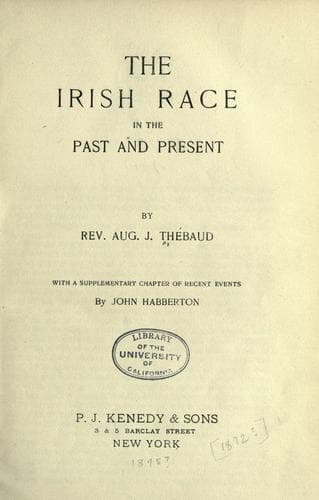
The Irish Race in the Past and the PresentThébaud, Augustus J.
History
The Irish Race in the Past and the Present
Thébaud, Augustus J.
Ireland -- History
In the old organization of Christendom, the key-stone of the
whole political edifice was the papacy. Up to the sixteenth
century, the Sovereign Pontiff had been acknowledged by all
Christian nations as supreme arbiter in international questions,
and if England did possess any shadow of authority over Ireland,
it was owing to former decisions of popes, who, being
misinformed, had allowed the Anglo-Norman kings to establish
their power in the island. Whatever may be thought of the bull
of Adrian IV., this much is certain: we do not pretend to solve
that vexed historical problem.
But, by rebelling against Rome, by rejecting the title of the
Pope, England threw away even that claim, and by the bull of
excommunication, issued against Elizabeth, the Irish were
released from their allegiance to her, supposing that such
allegiance had existed, solely built upon this claim.
So well was this understood at the time, that the Roman Pontiffs,
as rulers of the Papal States, the Emperors of Germany, as
heads of the German Empire, and the Kings of Spain and France,
always covertly and sometimes openly received the envoys of
O'Neill, Desmond, and O'Donnell, and openly dispatched troops
and fleets to assist the Irish in their struggle for their de
facto independence.
All this was in perfect accordance, not merely with the
authority which Catholic powers still recognized in the
Sovereign Pontiff, but even with the new order of things which
Protestantism had introduced into Western Europe, and which
England, as henceforth a leading Protestant power, had accepted
and eagerly embraced. By the rejection of the supreme
arbitration of the Popes, on the part of the new heretics,
Europe lost its unity as Christendom, and naturally formed
itself into two leagues, the Catholic and the Protestant. An
oppressed Catholic nationality, above all a weak and powerless
one, had therefore the right of appeal to the great Catholic
powers for help against oppression. And the pretension of
England to the possession of Ireland was the very essence of
oppression and tyranny in itself, doubly aggravated by the fact
of an apostate and vicious king or queen making it treason for a
people, utterly separate and distinct from theirs, to hold fast
to its ancient and revered religion.
Who can say, then, that Gregory XIII. was guilty of injustice
and of abetting rebellion when, in 1578, he furnished James
Fitzmaurice, the great Geraldine, with a fleet and army to fight
against Elizabeth? The authority greatest in Catholic eyes, and
most worthy of respect in the eyes of all impartial men--the
Pope-- thus endorsed the patent fact that Ireland was an
independent nation, and could wage war against her oppressors.
Here we have a stand-point from which to argue the question for
future times.
Public-domain text, read in full here on John Shaqi.
Reviews
Reviews
No reviews yet
Be the first to share your thoughts on this work.
Elsewhere in the archive
Join the Discussion
Join the discussion
Sign in to leave a comment or review.
Sign InorCreate an account