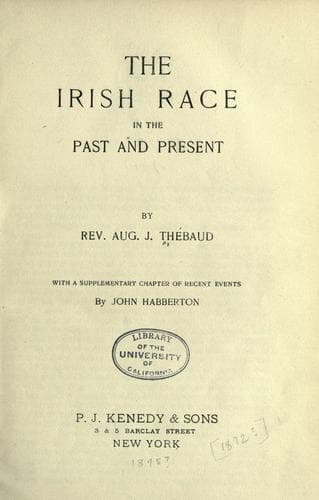
The Irish Race in the Past and the PresentThébaud, Augustus J.
History
The Irish Race in the Past and the Present
Thébaud, Augustus J.
Ireland -- History
The policy of Elizabeth toward the Irish nobility is well known
to our readers. The fate of the house of Desmond was, in her
mind, sealed from the beginning. It is now an ascertained fact
that she drove the great earl into rebellion, who, for a long
time, refused openly to avow his approbation of the
confederates' schemes, and even seemed at first to cooperate
with the queen's forces, in opposition to them. It was only
after his cousin Fitzmaurice and his brother John had been
almost ruined that, convinced of the determination of the
English Government to seize and occupy Munster with his five or
six millions of acres, he boldly stood up for his faith and his
country, and perished in the attempt.
It was then that "Protestant plantations" began in Ireland. The
confiscated estates of Desmond--which, in reality, did not
belong to him but to his tribe--were handed over to companies of
"planters out of Devonshire, Dorsetshire, and Somersetshire, out
of Lancashire and Cheshire, organized for defence and to be
supported by standing forces."--(Prendergast.)
Then the work set on foot by Henry II. in favor of Strongbow, De
Lacy, De Courcy, and others, was resumed, after an interval of
four hundred years, to be carried through to the end; that is to
say, to the complete pauperizing of the native race.
Among the "undertakers" and "planters" introduced into Munster
by Elizabeth, a word may not be out of place on Edmund Spenser
and Walter Raleigh, the first a great poet, the second a great
warrior and courtier. They both united in advocating the
extermination of the native race, a policy which Henry VIII. was
too high-minded to accept, and Elizabeth too great a despiser of
"the people" to notice. To Henry and Elizabeth Tudor the people
was nothing; the nobility every thing. Spenser, Raleigh, and
other Englishmen of note, who came into daily contact with the
nation, saw very well that account should be taken of it, and
thought, as Sir John Davies had thought before them, that it
ought to be "rooted out." That great question of the Irish
people was assuming vaster proportions every day; the people was
soon to show itself in all its strength and reality, to be
crushed out apparently by Cromwell, but really to be preserved
by Providence for a future age, now at hand to-day.
Spenser and Raleigh, being gifted with keener foresight than
most of their countrymen, were for the entire destruction of the
people, thinking, as did many French revolutionists of our own
days, that "only the dead never come back."
Public-domain text, read in full here on John Shaqi.
Reviews
Reviews
No reviews yet
Be the first to share your thoughts on this work.
Elsewhere in the archive
Join the Discussion
Join the discussion
Sign in to leave a comment or review.
Sign InorCreate an account