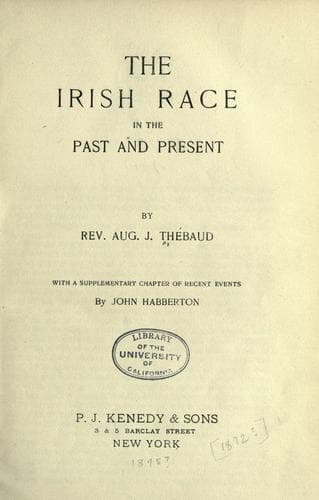
The Irish Race in the Past and the PresentThébaud, Augustus J.
History
The Irish Race in the Past and the Present
Thébaud, Augustus J.
Ireland -- History
1. The difficulty of effecting a joint and simultaneous effort
between the insurgent forces and the distant friendly power.
Help comes either too soon or too late, or lands on a point of
the coast where aid is worse than useless, and where it only
throws confusion into the ranks of the struggling native forces,
whose plans are thus all disarranged, disconcerted, and thrown
into confusion. Add to this the dangers of the sea, the possibly
insufficient knowledge of the soundings and of the nature of the
coast, the differences of spirit, customs, and language, of the
two coalescing forces, and it may be easily concluded that the
chances of success, as opposed to those of failure, are but
scanty.
2. The forces against which the coalition is made are always
immeasurably increased for the very purpose of meeting it, its
purport being always known beforehand. In the case under
consideration, it were easy to show that Elizabeth was prompted
by the fear of Spain to be speedy in crushing the attempted
"rebellions" in the south and north. Historians have made a
computation of the troops dispatched from England by the queen,
and of the treasure spent in these expeditions during her reign,
and the result is astonishing for the times. In fact, the whole
strength of England was brought into requisition for the purpose
of overpowering Ireland.
In our own days, the successful insurrection of Greece against
Turkey seems at variance with these considerations. But the
independence of the Greeks was brought about rather by the
unanimous voice of Europe coercing Turkey than by the few troops
sent from France, or by the few English or Poles who volunteered
their aid to the insurgents.
The remarks we have made may be further corroborated by the
reflection that the successful risings of oppressed
nationalities, recorded in modern history, were wholly effected
by the unaided forces of the insurgents. Thus, the seven cantons
of Switzerland succeeded against Austria, the Venetian Republic
against the barbarians of the North, the Portuguese in the
Braganza revolution against Spain, and the United Provinces of
the Low Countries against Spain and Germany.
The only historical instance which may contravene this general
rule is found in the Revolution of the United States of America,
where the French cooperation was timely and of real use, chiefly
because the foreign aid was placed entirely under the control
and at the command of the supreme head of the colonists, General
Washington.
These few words suffice for our purpose.
Public-domain text, read in full here on John Shaqi.
Reviews
Reviews
No reviews yet
Be the first to share your thoughts on this work.
Elsewhere in the archive
Join the Discussion
Join the discussion
Sign in to leave a comment or review.
Sign InorCreate an account