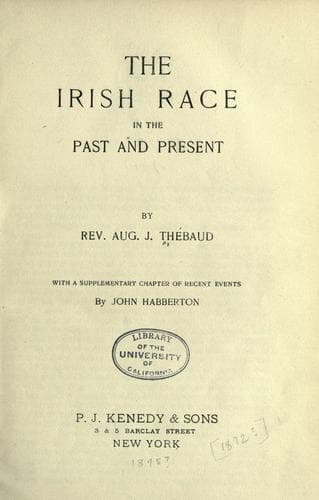
The Irish Race in the Past and the PresentThébaud, Augustus J.
History
The Irish Race in the Past and the Present
Thébaud, Augustus J.
Ireland -- History
"Sir Peter Carew has been seen murdering women and children, and
babies that had scarcely left the breast; but Sir Peter Carew
was not called on to answer for his conduct, and remained in
favor with the deputy. Gilbert, who was left in command at
Kilnallock, was illustrating yet more signally the same tendency.
" Nor "was Gilbert a bad man. As time went on, he passed for a
brave and chivalrous gentleman, not the least distinguished in
that high band of adventurers who carried the English flag into
the western hemisphere . . . . above all, a man of 'special
piety.' He regarded himself as dealing rather with savage beasts
than with human beings (in Ireland), and, when he tracked them
to their dens, he strangled the cubs, and rooted out the entire
brood.
"The Gilbert method of treatment has this disadvantage, that it
must be carried out to the last extremity, or it ought not to be
tried at all. The dead do not come back; and if the mothers and
babies are slaughtered with the men, the race gives no further
trouble; but the work must be done thoroughly; partial and
fitful cruelty lays up only a long debt of deserved and ever-
deepening hate.
"In justice to the English soldiers, however, it must be said
that it was no fault of theirs if any Irish child of that
generation was allowed to live to manhood."--(Hist. of Engl.,
vol. x., p. 507.)
These Munster horrors occurred directly after the defeat of the
Irish at Kinsale. Cromwell, therefore, in the atrocities which
will come under our notice, only followed out the policy of the
"Virgin Queen." And it is but too evident that the English of
1598 were the fathers or grandfathers of those of 1650. Both
were inaugurating a system of warfare which had never been
adopted before, even among pagans, unless by the Tartar troops
under Genghis Khan; a system which in future ages should shape
the policy, which was followed, for a short time, by the French
Convention in la Vendee.
Raleigh, as well as Spenser, seems to have been a vigorous
advocate of this system. It is true that his sole appearance on
the scene was on the occasion of the surrender of Smerwick by
the Spanish garrison; but the Saxon spirit of the man was
displayed in his execution of Lord Grey's orders, who, after,
according to all the Irish accounts, promising their lives to
the Spaniards, had them executed; and Raleigh appears to have
directed that execution, whereby eight hundred prisoners of war
were cruelly butchered and flung over the rocks in the sea. From
that time out the phrase "Grey's faith" (Graia fides) became a
proverb with the Irish.
Public-domain text, read in full here on John Shaqi.
Reviews
Reviews
No reviews yet
Be the first to share your thoughts on this work.
Elsewhere in the archive
Join the Discussion
Join the discussion
Sign in to leave a comment or review.
Sign InorCreate an account