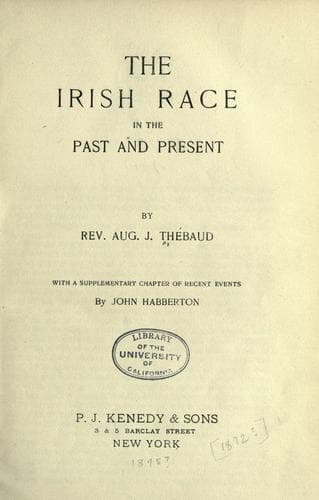
The Irish Race in the Past and the PresentThébaud, Augustus J.
History
The Irish Race in the Past and the Present
Thébaud, Augustus J.
Ireland -- History
After having succeeded in crushing Desmond and "planting "
Munster, the attention of Elizabeth was directed to the 0'Neills
and O'Donnells of Ulster. That thrilling history is well known.
It is enough to say that O'Donnell from his youth was designedly
exasperated by ill-treatment and imprisonment; and that as soon
as O'Neill, who had been treated with the greatest apparent
kindness by the queen, that he might become a queen's man,
showed that he was still an Irishman and a lover of his country,
he was marked out as a victim, and all the troops and treasures
of England were poured out lavishly to crush him and destroy the
royal races of the north.
In that gigantic struggle one feature is remarkable--that,
whenever the English Government felt obliged to come to terms
with the last asserters of Irish independence, the first
condition invariably laid down by O'Neill and O'Donnell was the
free exercise of the Catholic religion. For we must not lose
sight of the well-ascertained fact that the English queen, who
at the very commencement of her reign had had her spiritual
supremacy acknowledged by the Irish Parliament under pain of
forfeiture, praemunire, and high-treason, insisted all along on
the binding obligation of this title; and though at first she
had secretly promised that this law should not be enforced
against the laity, she showed by all her measures that its
observance was of paramount importance in her eyes.
Had the Irish followed the English as a nation, and accepted
Protestantism, Elizabeth would scarcely have made war upon them,
nor introduced her "plantations." All along the Irish were
"traitors" and "rebels" simply because they chose to remain
Catholics, and McGeoghegan has well remarked that, "not-
withstanding the severe laws enacted by Henry VIII., Edward VI.,
and Elizabeth, down to James I., it is a well-established truth
that, during that period, the number of Irishmen who embraced
the 'reformed religion' did not amount to sixty in a country
which at the time contained two millions of souls." And
McGeoghegan might have added that, of these sixty, not one
belonged to the people; they were all native chieftains who sold
their religion in order to hold their estates or receive favors
from the queen.
Public-domain text, read in full here on John Shaqi.
Reviews
Reviews
No reviews yet
Be the first to share your thoughts on this work.
Elsewhere in the archive
Join the Discussion
Join the discussion
Sign in to leave a comment or review.
Sign InorCreate an account