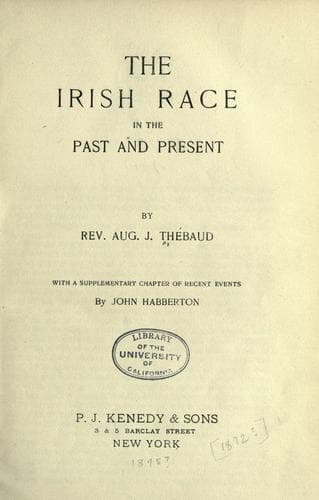
The Irish Race in the Past and the PresentThébaud, Augustus J.
History
The Irish Race in the Past and the Present
Thébaud, Augustus J.
Ireland -- History
Let it be remembered that, at the period of which we speak, the
only real question involved in the contest was gradually
assuming more and more a religious character. Henry VIII. and
his deputy, St. Leger, had struck a fatal blow at clanship and
Irish institutions in general, by bestowing on and compelling
the chieftains to accept English titles, and by investing them
with new deeds of their lands under feudal tenure. By Elizabeth,
the same policy was steadily and successfully pursued, her court
being always graced by the presence of young Irish lords,
educated under her own eyes, and loaded with all her royal
favors. All she asked of them in return was that they should
become Queen's men. The repugnance once felt by Irishmen for
that gilded slavery was each day becoming less marked. But,
while every thing was seemingly working so well for the
attainment of Elizabeth's object at the commencement of her
reign, a new feature suddenly shows itself, and grows rapidly
into prominence --the attachment of the Irish to their religion,
and the violent opposition to the change always kept foremost in
view by the queen, namely the substitution of her spiritual
supremacy for that of the Pope.
Thus we find the Irish leaders, when proclaiming their
grievances, either on the eve of war, or the signing of a treaty
of peace, always giving their religious convictions the first
place on the list. The religious question, then, was becoming
more and more the question, and, notwithstanding all her fine
assurances that she would not infringe upon the religious
predilections of the laity, Elizabeth's great purpose, in
Ireland and in England, was to destroy Catholicity, by
destroying the priesthood, root and-branch.
The nobles showed how fully convinced they were of this, when
they carne to adopt a system of concealment, even of duplicity,
to which Irishmen ought never to have been weak enough to submit.
Not only were the practices of their religion confined to
places where no Englishman or Protestant could penetrate, but
gradually they allowed their houses--those sanctuaries of
freedom--to be invaded by the pursuivants of the queen,
searching for priests or monks "lately arrived from Rome."
Secret apartments were constructed by skilful architects in
noblemen's manors; recesses were artfully contrived under the
roofs, in roomy staircases, or even in basements and cellars.
There the unfortunate minister of religion was confined for
weeks and months, creeping forth only at night, to breathe the
fresh air at the top of the house or in the thick shrubbery of
the adjoining park. All the means of evading the law used by the
Christians of the first centuries were reproduced and resorted
to in Catholic Ireland by chieftains who possessed the "secret
promise" of the queen that their religion should not be
interfered with, and that her supremacy should not be enforced
against them.
Public-domain text, read in full here on John Shaqi.
Reviews
Reviews
No reviews yet
Be the first to share your thoughts on this work.
Elsewhere in the archive
Join the Discussion
Join the discussion
Sign in to leave a comment or review.
Sign InorCreate an account