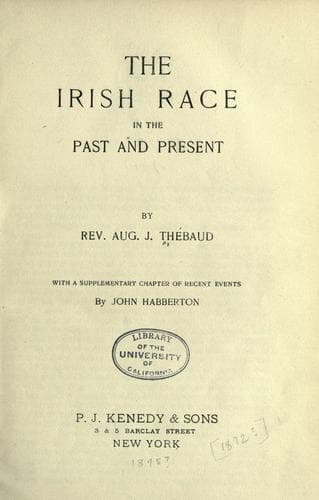
The Irish Race in the Past and the PresentThébaud, Augustus J.
History
The Irish Race in the Past and the Present
Thébaud, Augustus J.
Ireland -- History
First, the question might arise as to how far the Irish were
subject to the English crown. We have seen how, a few years
before, Gillapatrick, of Ossory, asserted his right of making
war on England, when he felt sufficient provocation. Under
Elizabeth the case was still clearer, at least for Catholics,
after the excommunication of the queen by Pius V. As we have
seen, the chief title of England to Ireland rested on two
pretended papal bulls: another Pope could and did recall the
grant, which had been founded on misrepresentation. Up to that
time, there had been no real subjection by conquest, outside of
the Pale, which formed but an insignificant part of the island.
Under such circumstances, it must at least be admitted that a
radically and clearly unjust law, imposed by a foreign though
perhaps suzerain power, could be justly resisted by force of
arms. And such was the case in Ireland. The Queen of England--
the Irish Parliament of 1539 had no other authority than that of
the queen, and represented no part of the people--had made it
rebellion for the Irish to remain faithful to their religion.
What could prevent the Irish from resisting such pretension,
even at the cost of effusion of blood? The early Christians,
under the Roman Empire, it is true, never rose in arms against
the bloody edicts of the Caesars or the Antonines; but the cases
are not parallel.
Suppose that Greece or Asia Minor had never succumbed to the
Roman power, and had become entirely Christian: no one would
refuse to admit their right to offer armed resistance to the
extension of the edicts of persecution into their territory. On
the contrary, it would have been their duty to do so: and every
one of their inhabitants, who was taken and executed as a rebel,
would have been crowned with the martyr's crown.
At this point, indeed, comes in the consideration of the special
motive which animated each belligerent, even when fighting on
the right side. We are far from saying that all the Irishmen,
particularly the leaders and chieftains who at that time ranged
themselves under the banners of the Desmonds or the O'Neills,
fought purely for Christ and religion. Many of them, no doubt,
engaged in the contest from mere worldly motives, perhaps even
for purposes unworthy of Christians; and in this case, those who
fell in the struggle were in no sense soldiers of Christ.
But how many such are to be found among the bishops, priests, or
monks, who perished under Elizabeth? May it not be said of them
that, to a man, they fell for the sake of religion? We may even
be bold enough to say that the majority of the common Irish
people who lost their lives in those wars may be placed in the
same category as their spiritual rulers, being in reality the
upholders of right and the champions of Catholicity.
Public-domain text, read in full here on John Shaqi.
Reviews
Reviews
No reviews yet
Be the first to share your thoughts on this work.
Elsewhere in the archive
Join the Discussion
Join the discussion
Sign in to leave a comment or review.
Sign InorCreate an account